Introduction
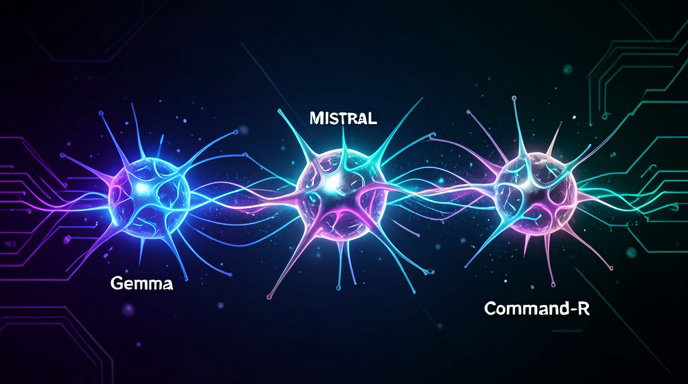
The landscape of large language models has expanded dramatically, with multiple options available for different use cases and deployment scenarios. Three models have emerged as significant players: Gemma (developed by Google), Mistral (created by Mistral AI), and Command-R (built by Cohere). Each brings distinct strengths, licensing approaches, and performance characteristics to the table. Understanding how these models compare across capability, efficiency, open-source availability, and practical applications is essential for organizations and developers choosing the right tool for their specific needs.
Overview of the Three Models
Gemma represents Google's entry into the open-source large language model space, designed to be efficient enough to run on developer laptops and desktop computers while maintaining competitive performance. The Gemma family includes multiple sizes, with Gemma 2 27B being a notable variant that balances capability with accessibility.
Mistral offers a range of models from the compact 7B version to more sophisticated mixture-of-experts architectures like the 8x7B Mixtral and 8x22B Mixtral. These models are available under the Apache 2.0 license and represent state-of-the-art performance in the open-source domain.
Command-R comes in multiple versions, including the March 2024 release and the more recent August 2024 update, with Command-R+ representing an enhanced variant. Developed by Cohere, Command-R is optimized for enterprise applications with particular strengths in multilingual capabilities and retrieval-augmented generation (RAG).
Open-Source Availability and Licensing
A fundamental distinction between these models lies in their open-source status. Gemma is available as open source, making it freely accessible for developers and organizations without licensing restrictions. Similarly, Mistral models operate under the Apache 2.0 license, providing broad availability and commercial usability. This contrasts with Command-R, which is proprietary and not open source.
The open-source nature of Gemma and Mistral enables developers to run these models locally on their own hardware, which is particularly valuable for privacy-sensitive applications, cost-conscious deployments, and organizations with specific compliance requirements. Gemma's design specifically prioritizes the ability to run on standard developer hardware.
Performance Across Key Benchmarks
Performance metrics reveal nuanced differences in how these models handle various cognitive tasks.
MMLU (Massive Multitask Language Understanding) tests knowledge across 57 subjects including mathematics, history, and law. Gemma 2 27B achieves 75.2% accuracy on the 5-shot version, while Command R (August 2024) reaches 67%. This indicates Gemma's strength in broad knowledge retention.
Code Generation shows a different pattern. Command R achieves 70% on HumanEval, a benchmark evaluating code generation and problem-solving capabilities, compared to Gemma 2 27B's 51.8% pass rate. This suggests Command-R's superiority for coding tasks.
Mathematical Problem-Solving is closely matched. Gemma 2 27B scores 42.3% on the MATH benchmark (4-shot), while Command R scores 40%, indicating comparable mathematical reasoning abilities with a slight edge to Gemma.
Specialized Reasoning shows distinctions in higher-level tasks. An older comparison between Command-R (March 2024) and Mistral Large (February 2024) reveals Mistral Large leading with 35.1% on GPQA, a challenging reasoning benchmark, compared to Command-R's 28.4%. However, Command-R+ outperforms Gemma 2 27B on several benchmarks including HellaSwag and Winogrande, while Gemma 2 27B performs better on ARC-C and GSM8k.
These benchmark variations suggest that different models excel at different cognitive tasks, making the optimal choice dependent on the specific application.
Context Window and Technical Specifications
Context window—the number of tokens a model can process in a single request—has significant implications for handling longer documents and complex queries. Command R (August 2024) supports 128K tokens, providing substantial capacity for processing extensive documents and maintaining conversational history. Gemma 2 27B operates with 8,192 tokens, a more limited but still functional window suitable for typical conversational and coding tasks.
The 8x22B Mixtral from Mistral represents state-of-the-art performance in the open-source domain, though specific context window specifications are not provided in available comparisons.
Cost and Pricing Analysis
Pricing is a critical factor for organizations deploying these models at scale. The pricing landscape reveals dramatic differences in cost structure.
Gemma 3 27B offers the most aggressive pricing at $0.30 blended per million tokens ($0.10 input, $0.20 output). Command-R+ costs $12.50 blended per million tokens ($2.50 input, $10.00 output), representing 98% higher costs than Gemma 3 27B.
An earlier comparison showed Command-R (March 2024) at $0.50 per million tokens, positioning it as the most affordable option at that time, with Mistral Large commanding premium pricing.
These pricing differences fundamentally impact total cost of ownership, particularly for high-volume applications. Organizations processing millions of tokens monthly will see substantial savings with Gemma, while those prioritizing specific performance characteristics of Command-R or Mistral must factor in the cost premium.
Throughput and Generation Speed
Throughput—measured in tokens generated per second—affects real-time application performance. Command-R+ generates 79.5 tokens per second, while Gemma 3 27B produces 33 tokens per second. This 2.4x difference in throughput means Command-R+ delivers responses significantly faster, an important consideration for latency-sensitive applications like real-time chat interfaces.
Enterprise Capabilities: RAG, Multilingual Support, and Tool Use
Command-R (August 2024) is specifically engineered for enterprise applications with enhanced multilingual retrieval-augmented generation capabilities and tool use functionality. This design focus makes it particularly suitable for organizations requiring sophisticated document retrieval systems, multilingual support across various languages, and integration with external tools and APIs.
Mistral similarly offers sophisticated capabilities, though its positioning emphasizes open-source accessibility and competitive performance with commercial alternatives.
Gemma, while powerful, is primarily positioned as an efficient model for developers and general-purpose applications rather than specialized enterprise workflows.
Best-Fit Use Cases
Chat Applications: Gemma's open-source availability and ability to run locally make it ideal for organizations building chat systems where privacy and control are important. Its strong MMLU performance supports knowledgeable conversational responses. However, Command-R's faster throughput (79.5 vs 33 tokens/second) would provide superior user experience in real-time chat interfaces if cost is not a limiting factor.
Retrieval-Augmented Generation (RAG): Command-R and Command-R+ are explicitly optimized for RAG systems, making them the primary choice for applications requiring document retrieval, knowledge base integration, and context-aware responses based on external sources.
Coding Tasks: Command-R significantly outperforms Gemma on code generation benchmarks (70% vs 51.8% HumanEval), making it the superior choice for coding assistance and development support applications.
Lightweight Deployment: Gemma excels in scenarios requiring local execution on standard hardware, edge deployment, or resource-constrained environments. Its open-source nature eliminates licensing concerns for these deployments.
Cost-Conscious High-Volume Applications: Gemma 3 27B's $0.30 per million token pricing makes it optimal for organizations processing massive token volumes where cost efficiency drives decision-making.
Multilingual Applications: Command-R's enhanced multilingual capabilities position it as the best choice for organizations operating in multiple languages globally.
Specialized Reasoning Tasks: For applications requiring advanced reasoning on challenging problems, Mistral Large's 35.1% GPQA performance suggests superiority, though this advantage must be weighed against higher costs and different deployment options.
Comparative Summary
Gemma represents the most accessible and cost-effective option, particularly suitable for developers, local deployment, and organizations prioritizing efficiency and cost over specialized enterprise features. Its open-source status and ability to run on standard hardware eliminate deployment friction.
Mistral positions itself as a high-performance open-source alternative, with the 8x22B Mixtral representing state-of-the-art performance in the open-source space. It balances performance with accessibility, available through both open-source channels and commercial APIs.
Command-R (and particularly Command-R+) targets enterprise organizations willing to accept higher costs in exchange for specialized capabilities in RAG, multilingual support, tool integration, and faster generation speeds. Its design reflects the needs of sophisticated business applications requiring reliable, performant models with specific enterprise features.
Selection Framework
Organizations choosing between these models should consider five primary dimensions: budget constraints, latency requirements, deployment preferences, task specialization, and scale of operations. Budget-constrained or high-volume applications favor Gemma. Latency-sensitive real-time applications favor Command-R. Organizations valuing open-source development and local control should prioritize Gemma or Mistral. Applications requiring specialized RAG or multilingual capabilities demand Command-R. And organizations seeking maximum capability without cost constraints should evaluate Mistral Large or Command-R+.
Compare Gemma, Mistral, and Command-R with AI4Chat
If you’re reading about Gemma, Mistral, and Command-R, AI4Chat gives you a practical way to test how each model performs on the tasks that matter most. Instead of relying on specs alone, you can compare them side by side, refine your prompts quickly, and see which model produces the best results for real-world writing, research, and problem-solving.
Side-by-side model comparison for real work
Use AI4Chat’s AI Playground to evaluate these models in the same environment and on the same prompts. That makes it easier to judge output quality, style, speed, and usefulness without switching between tools.
- Compare Chat outputs across multiple AI models in one place
- Test the same prompt on Gemma, Mistral, Command-R, and more
- See which model handles your exact use case best
Faster prompt testing and cleaner results
When a model needs better instructions, AI4Chat helps you improve your prompts and polish the final response. The Magic Prompt Enhancer turns rough ideas into stronger prompts, while the AI Humanizer makes output sound more natural and ready to use.
- Magic Prompt Enhancer for stronger, more precise prompts
- AI Humanizer for more natural-sounding final text
- Save time refining outputs for content, analysis, and drafting
Go beyond chat with files, code, and deployment
AI4Chat is also useful when your comparison goes beyond simple text generation. You can upload files for context, ask the models to work with documents or images, and even turn the best idea into an app with zero coding. That makes it easier to move from model evaluation to real implementation.
- AI Chat with Files and Images for context-aware testing
- AI Code Assistance for programming and debugging tasks
- AI Text to App for turning ideas into working apps without coding
Conclusion
Gemma, Mistral, and Command-R each serve different priorities in the modern AI model landscape. Gemma stands out for affordability, local deployment, and broad accessibility, while Mistral offers strong open-source performance with impressive reasoning capabilities. Command-R, especially in its newer variants, is tailored for enterprise use cases where multilingual support, RAG, tool use, and fast generation matter most.
The best choice depends less on raw benchmark numbers alone and more on the practical needs of the deployment. Teams should weigh cost, speed, control, and specialization carefully before deciding which model fits their workflow, budget, and long-term goals.