How to Find Hidden Jobs: The Complete Guide to the Job Market You Can't See on LinkedIn
Most good jobs get filled before they're ever "posted" anywhere you'd normally look. They sit on company career pages and inside applicant tracking systems for days or weeks before they show up on the big boards, if they ever do. And by the time a role hits LinkedIn or Indeed, hundreds of people are already in line. This guide covers the whole thing in practical terms: why the hidden job market exists, where unadvertised jobs actually live, five ways to dig them out yourself (including copy-paste ATS search strings), and the purpose-built engines that do the digging for you every day: HiddenRoles, UnlistedRemote, Fresherify, HireCream, FreeJobs and RezPolish.
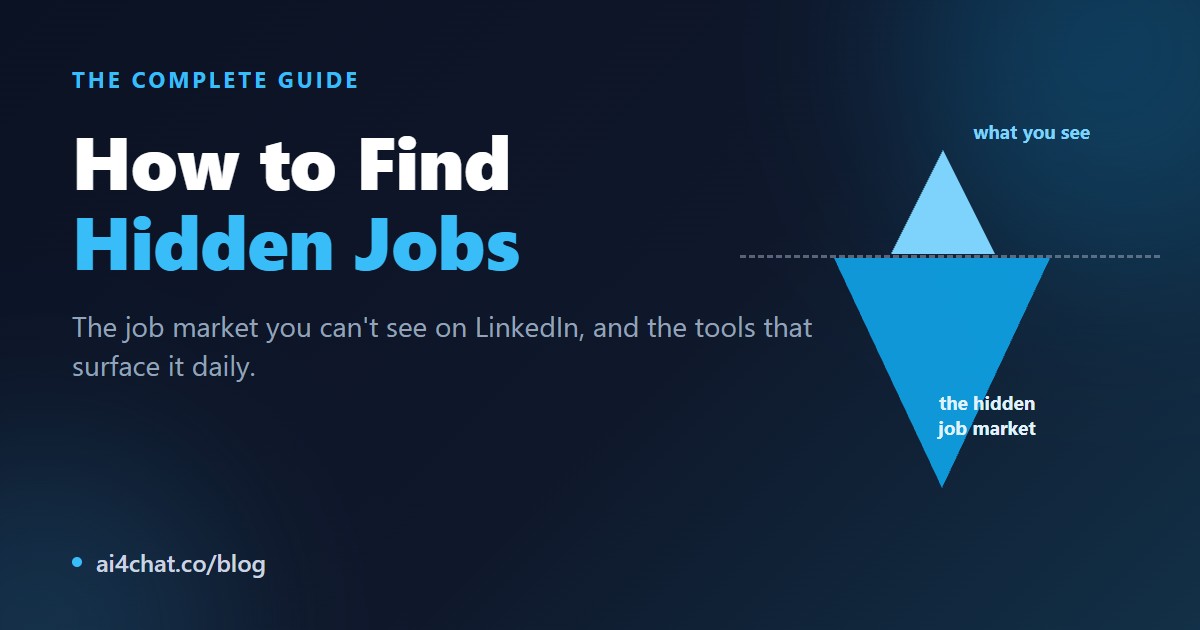
What is the "hidden job market", really?
The hidden job market is every open role that isn't being actively advertised on the major aggregators: LinkedIn, Indeed, ZipRecruiter, Glassdoor. Career coaches have argued for decades about how big it is. Most estimates land somewhere between 50% and 80% of all hires. You don't have to trust any exact figure, though, because the reasons behind it are simple and nobody seriously disputes them:
- Posting costs money and attention. Sponsored slots on the big boards are paid. Plenty of companies only ever post a role on their own careers page. It's free, and the candidates they actually want tend to find it anyway.
- Every job starts on the company's own system first. A role gets created in an applicant tracking system (ATS) like Greenhouse, Lever, Workday or Ashby. It goes live on the careers page within minutes. Syndication to the boards comes later, if at all.
- Recruiters repost with a delay, and a filter. Agency reposts strip out the company name, add a middleman, and often stay up long after the role is filled. That's the classic "ghost job".
- Referrals eat postings. If the hiring manager finds someone during the first quiet week, the role never needs advertising at all.
So the public boards end up showing you a delayed, filtered, crowded subset of what's actually open. The freshest and least contested roles are sitting in plain sight on tens of thousands of career pages. They're just not aggregated anywhere you normally browse.
Why the big boards keep showing you the same crowded jobs
It helps to walk through the life of a single job. A recruiting coordinator opens a requisition in the ATS on day zero. The careers page updates within minutes. Getting it onto the aggregators is a separate step, often a paid one, and even when it happens automatically the aggregators crawl and dedupe on their own schedule. Meanwhile applications pile up on whichever surface the job is visible.
| Timeline | Where the job is visible | Typical competition |
|---|---|---|
| Day 0-3 | Company careers page + ATS board only | A handful of applicants, mostly referrals and people who watch career pages |
| Day 3-14 | Trickles onto some aggregators; recruiters may repost it | Dozens to low hundreds |
| Day 14+ | Everywhere, including boards it was never officially posted to | Hundreds or more; "Easy Apply" pile-ups; screening gets keyword-brutal |
| After filling | Often STILL live on aggregators (ghost jobs) | Doesn't matter. Applications go nowhere |
Two other problems deserve a mention. Recruiter reposts swap the employer for an agency, so your application lands in a middleman's funnel instead of the company's. And ghost jobs (postings for roles that are already filled, frozen, or were never real) are mostly an aggregator problem, since aggregators have little reason to take stale inventory down quickly. Go to the source and both problems mostly disappear.
Method 1: Go straight to company career pages
The simplest version of hidden-job hunting. Build a list of 50-150 companies you'd actually want to work for, then check their careers pages directly. You see roles on day zero, and the application form at the end belongs to the company itself.
- Build the list fast: start with competitors of companies you like, "best places to work" lists in your niche, the portfolio pages of VCs that fund your industry, and sponsors of your field's conferences.
- Bookmark the careers URL, not the homepage. Most follow predictable patterns:
/careers,/jobs, or a hosted ATS page (more on that next). - Batch it: 20 minutes, twice a week, same list every time. Once the list feels familiar, new postings jump out at you.
The catch is scale. Nobody can watch ten thousand career pages by hand. That's the gap the dedicated engines further down close for you, but even manually, a tight 50-company watchlist will surface roles your competition hasn't seen yet.
Method 2: X-ray the applicant tracking systems (copy-paste searches)
Here's the trick most guides skip. Companies rarely build their own job pages. They host them on a handful of ATS platforms, and each platform uses a predictable public URL. Which means Google can search a huge slice of the hidden job market for you, one platform at a time. Recruiters call these "x-ray" searches:
| ATS platform | Public URL pattern | Copy-paste Google search |
|---|---|---|
| Greenhouse | boards.greenhouse.io/… | site:boards.greenhouse.io "product manager" "remote" |
| Lever | jobs.lever.co/… | site:jobs.lever.co "data analyst" "London" |
| Ashby | jobs.ashbyhq.com/… | site:jobs.ashbyhq.com "frontend engineer" |
| Workable | apply.workable.com/… | site:apply.workable.com "customer support" -senior |
| Workday | *.myworkdayjobs.com | site:myworkdayjobs.com "financial analyst" "entry" |
| SmartRecruiters | jobs.smartrecruiters.com/… | site:jobs.smartrecruiters.com "marketing" "hybrid" |
| BambooHR | *.bamboohr.com/careers | site:bamboohr.com inurl:careers "operations" |
You can sharpen any of these with normal Google operators. Add -senior -principal to cut seniority you don't want. Use the time filter (Tools, then "Past week") for freshness. Put exact titles in quotes, and use OR-groups like ("junior" OR "associate" OR "entry level"). Every result is a live ATS page. No middleman, no repost, and you apply straight into the company's own pipeline.
Method 3: Set alerts so the jobs come to you
Any x-ray search that works once will keep working. Wrap your three best searches in Google Alerts, set them to "as-it-happens", and new postings land in your inbox on day zero or one. It's also worth adding a company-specific alert for each of your top ten dream employers, something like site:boards.greenhouse.io/acme "engineer". That's a watchlist without the watching.
Method 4: Work the referral seam
Referrals fill roles before they get advertised, so a little outreach multiplies everything above. When you find a day-zero posting, look up one person on that team and send a short, specific note. You'll often be the first person to reach out about that role. That's a very different conversation than being applicant #400 in the pile.
Method 5: Let a purpose-built engine do all of it, daily
Everything above works. Everything above is also work. The manual pipeline of watchlists, x-rays and alerts takes hours every week, and it still only covers the companies you thought to include. A newer breed of tools runs that whole loop for you: they scan career pages and ATS boards continuously, dedupe the results, filter out recruiting agencies, match roles against your profile, and hand you a fresh feed each day.
Below are six of these tools we know inside out. Each has a different specialty. They all share the same DNA (jobs sourced from company career pages and ATS systems, agency reposts filtered out, direct application links), but they're built for different job seekers.
1. HiddenRoles: the flagship hidden-jobs engine
HiddenRoles is the general-purpose engine and the best starting point for most people. It continuously scans company careers pages and applicant tracking systems, and its whole product is the exact thing this article is about: jobs that aren't being advertised on the big job boards.
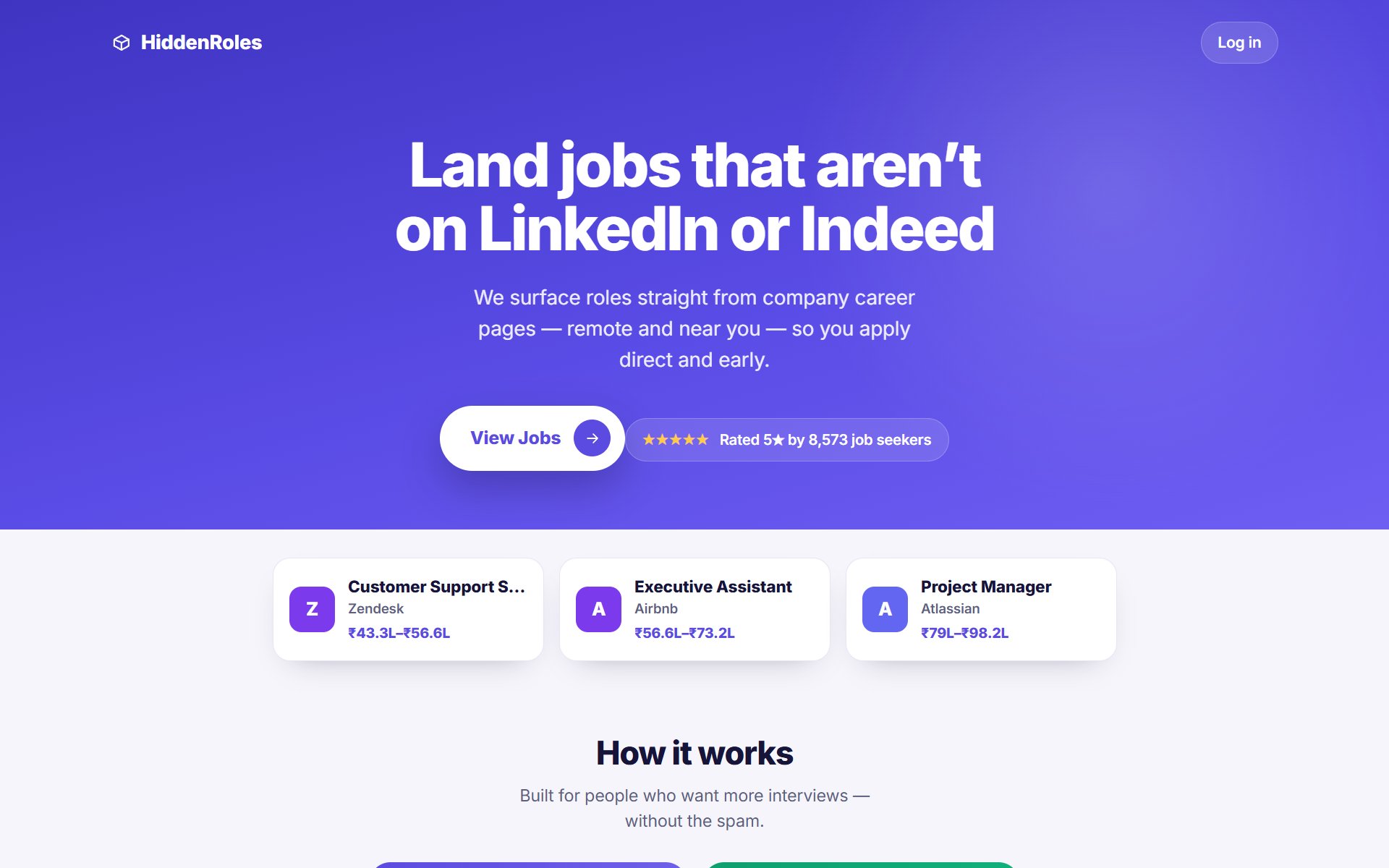
- Personalized matching: a short onboarding questionnaire (role, experience, location, salary, work style) trains your feed, and AI broadens your titles to adjacent ones so you don't miss roles filed under a different name.
- Direct-to-company only: recruiting-agency reposts are filtered out by default. Every card links to the employer's own application page.
- Region-aware: job seekers outside the US get their own country's openings first, then worldwide remote roles, instead of a US-only firehose.
- Search that gets what you mean: type "fresher jobs" or "work from home" and it applies real experience and remote filters rather than failing as a literal title search.
Best for: anyone who wants the widest daily coverage of unadvertised roles in one feed. You can preview the feed free before committing to anything.
2. UnlistedRemote: remote-only, worldwide
UnlistedRemote points the same engine at a single obsession: remote hidden jobs. Everything in the feed is remote. No "hybrid, 3 days in office" bait. Just roles pulled from the career pages of companies that actually hire distributed teams.
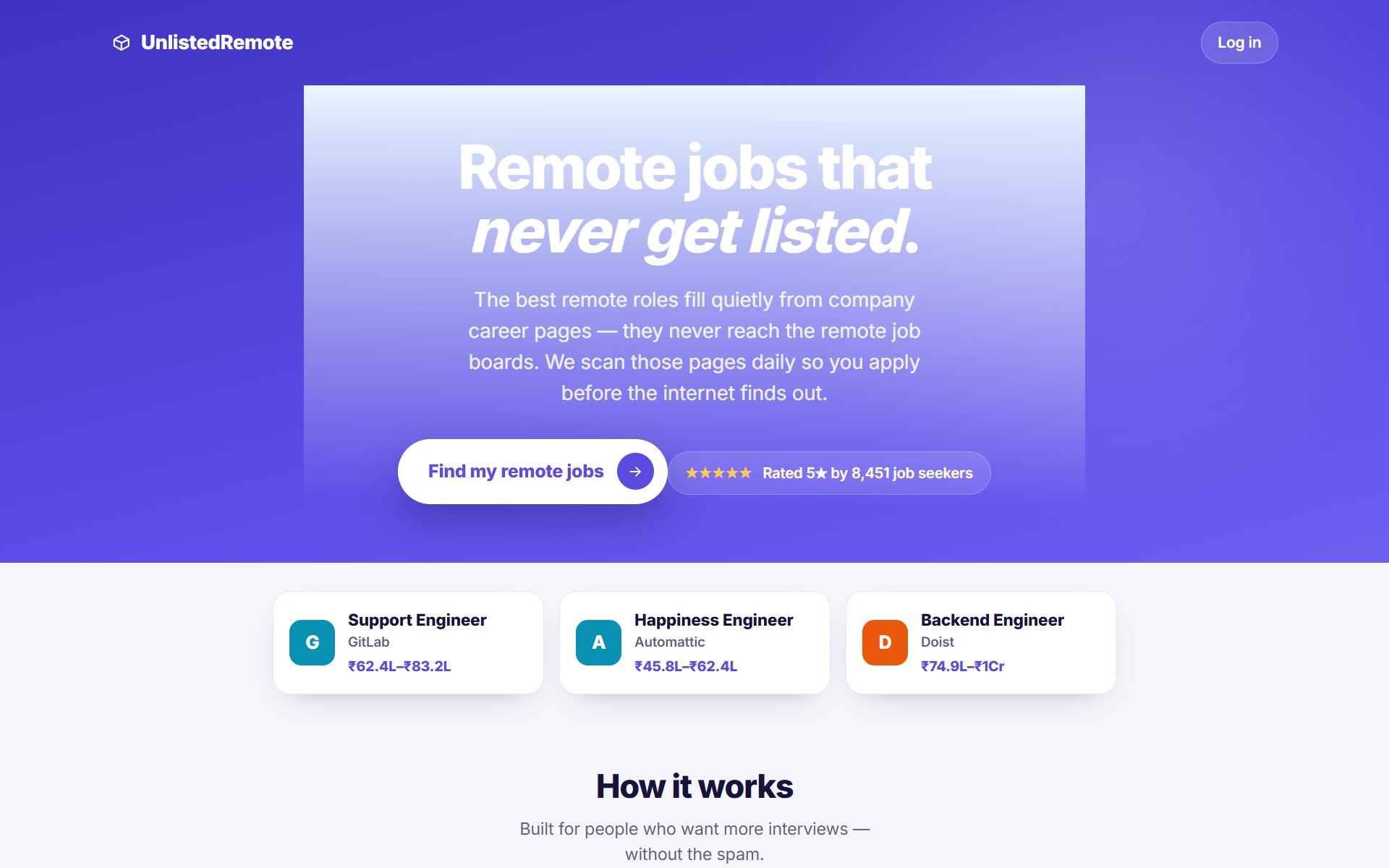
- Remote-first inventory: remote is the most competitive segment on the public boards, which makes catching these roles at the career-page stage matter even more.
- Global reach: remote roles show up wherever the company is headquartered, with country filters so you can check work-authorization fit quickly.
Best for: committed remote workers, and anyone living outside the major hiring hubs.
3. Fresherify: entry-level and first jobs
Fresherify tackles the most painful version of this problem. Entry-level roles on public boards attract enormous piles of applicants, and everyone has seen the "entry level, 5 years of experience required" listings. Fresherify's feed is filtered to genuinely entry-level and junior hidden jobs, with an extra layer that strips out senior-titled roles the source data misclassified.
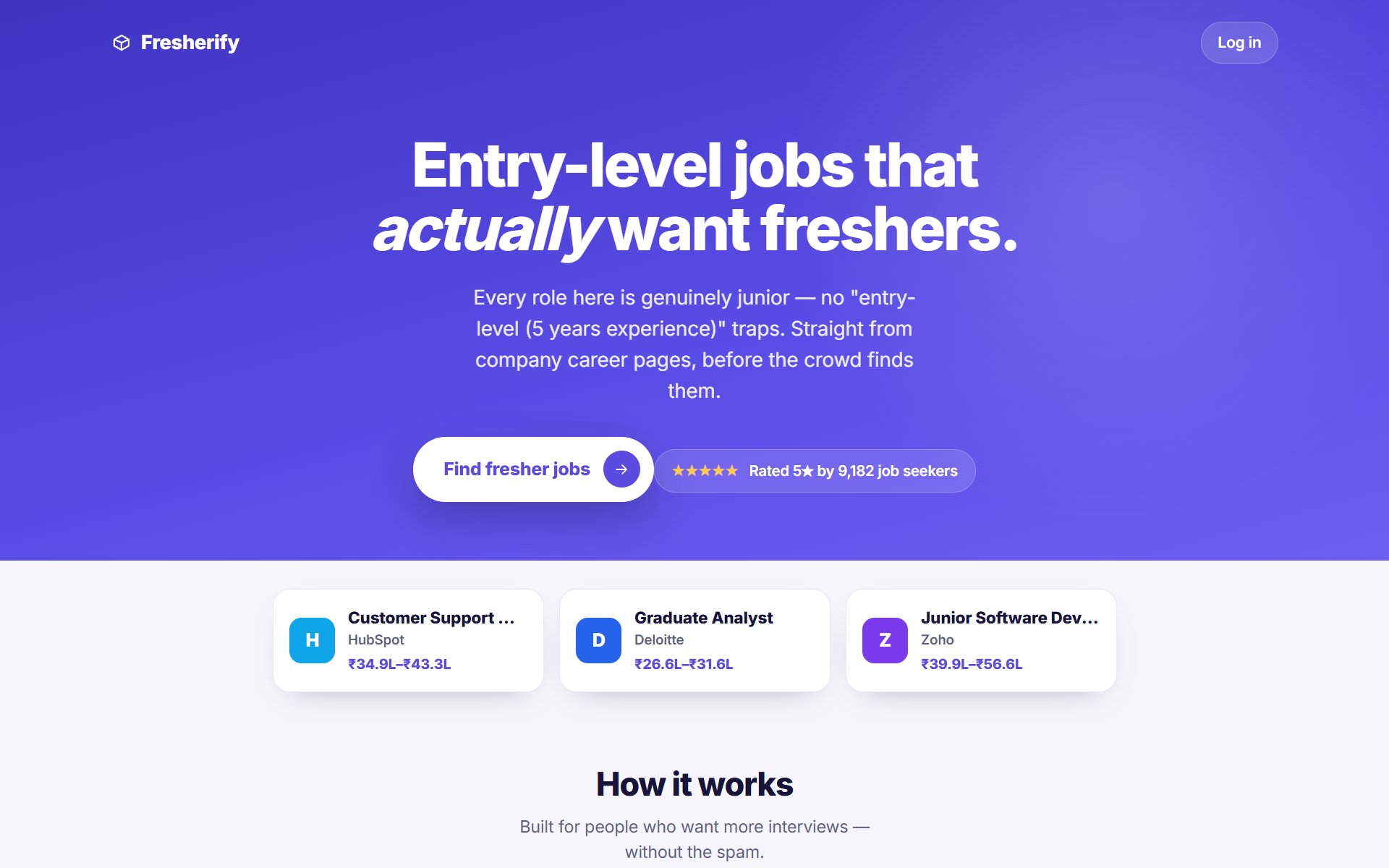
- Level-true listings: Entry and Junior filtering at the data level, plus title checks, so a "Senior Staff Engineer" never sneaks onto an entry-level board.
- Fresher-friendly search: built around how early-career candidates actually type ("fresher", "graduate", "no experience") and matched to real openings instead of literal title lookups.
Best for: students, fresh graduates, and career changers with 0-2 years of experience.
4. HireCream: quality of employer first
HireCream ranks the same hidden-job inventory on a different axis: the quality of the employer. Every company gets a composite score, and the best-scored employers float to the top of your feed. Instead of wading through everything, you start each day with the cream.
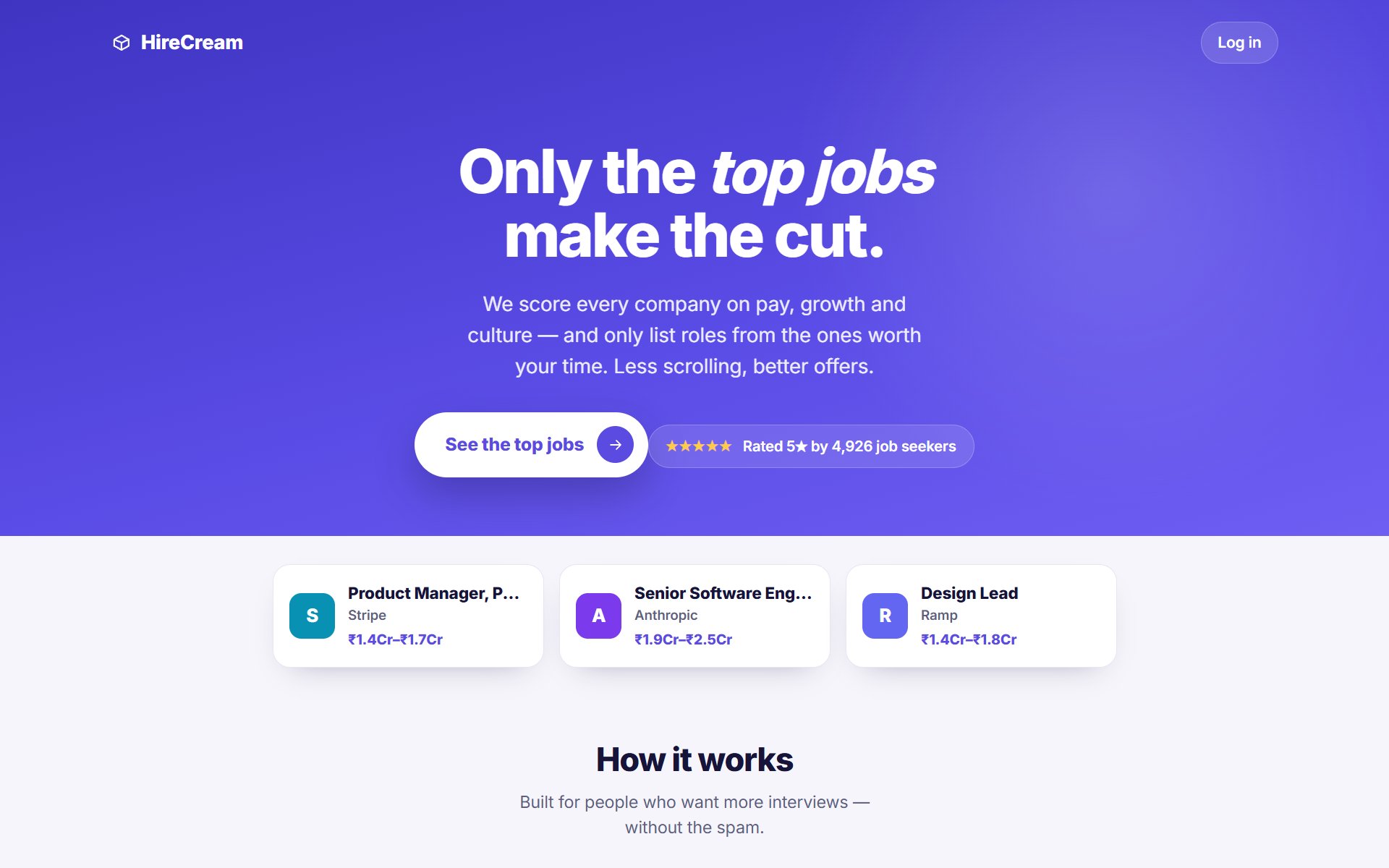
- Employer scoring: feeds lead with companies that score well on pay, growth and culture, not just companies that posted most recently.
- Same direct-apply DNA: career-page and ATS sourcing with agency reposts filtered out.
Best for: experienced candidates who are optimizing for where they work, not just whether they land an offer.
5. FreeJobs: the no-cost way in
FreeJobs is the lowest-friction door into the hidden job market: browse hidden jobs free. If you're not sure the hidden-market thesis is real, this is the fastest way to see the inventory with your own eyes and compare it against what LinkedIn shows you for the same search.
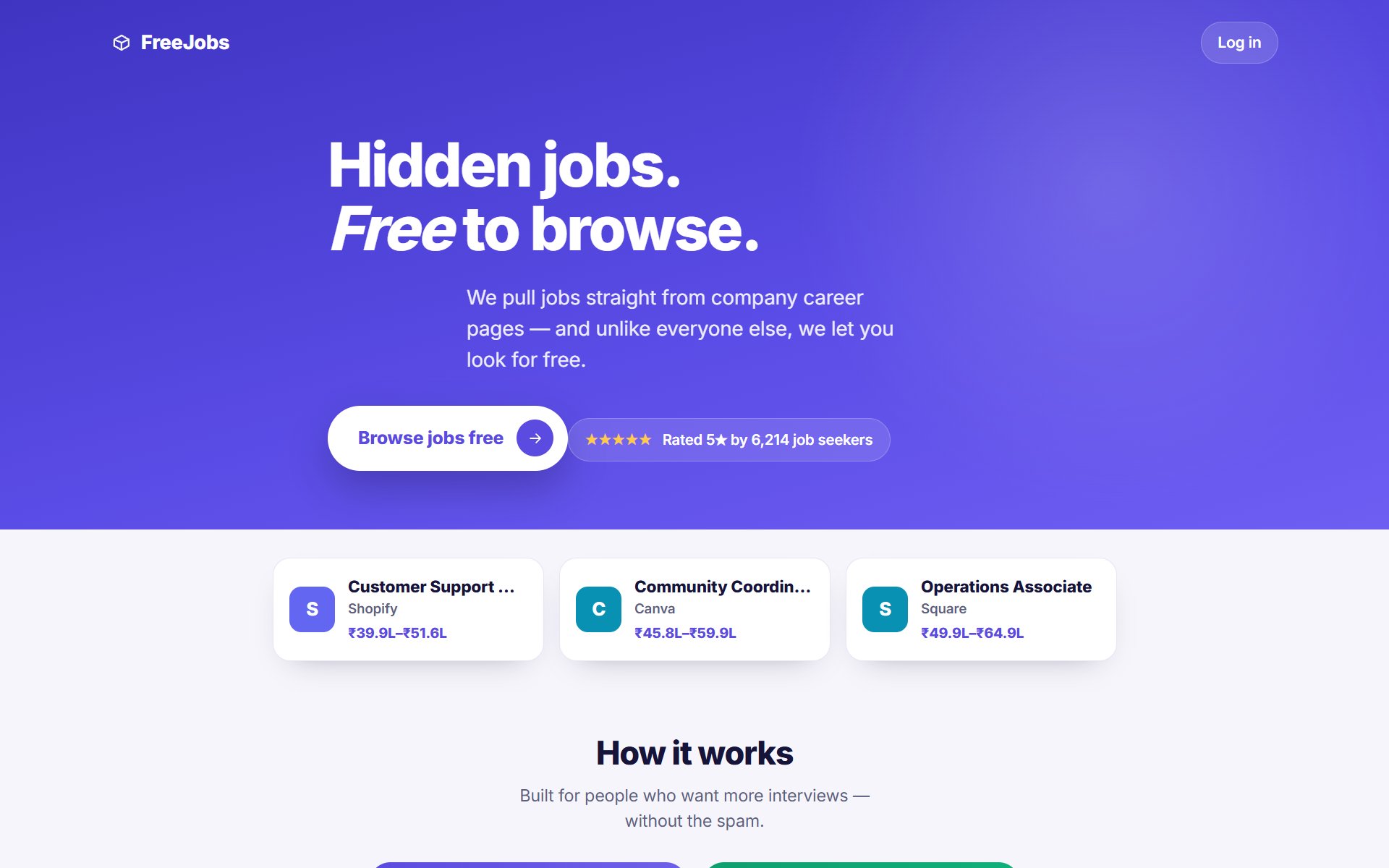
- Free browsing: see real, current, career-page-sourced listings before spending anything.
- Full engine underneath: the same de-duplicated, direct-to-company inventory as its siblings.
Best for: skeptics, casual lookers, and anyone job hunting on a budget of zero.
6. RezPolish: fix the resume before it hits the pile
The last tool attacks the other half of the equation. Finding an uncrowded posting improves your odds a lot. A resume that survives ATS parsing improves them again. RezPolish is an AI resume analysis and polish tool. Paste your resume and it comes back with concrete, line-level improvements: quantified achievements, keyword coverage for your target roles, and formatting that automated screeners parse cleanly.
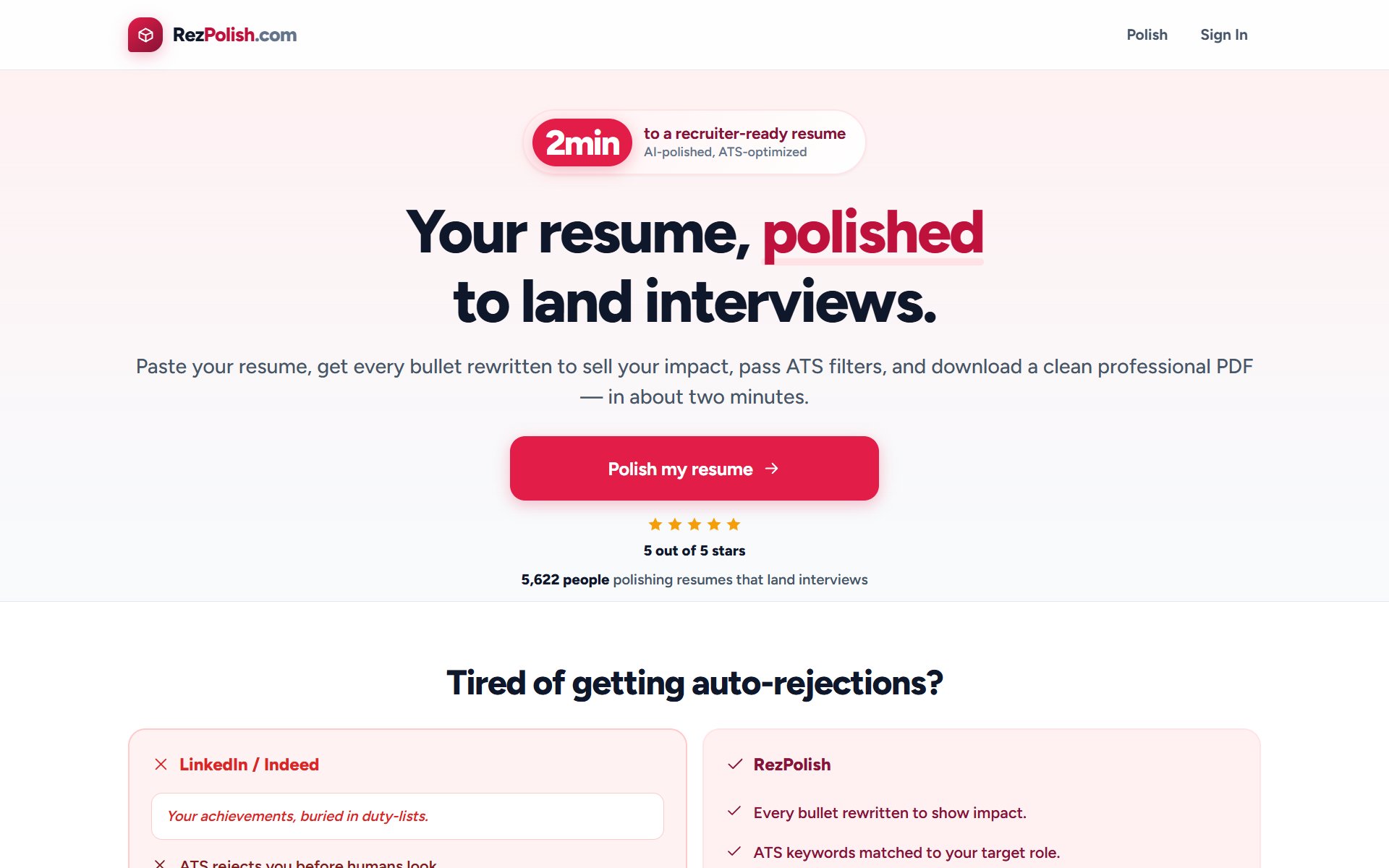
- ATS-aware rewriting: suggestions tuned to how tracking systems actually score and parse resumes.
- Pairs with everything above: polish once, then apply to day-zero postings with a document that converts.
Best for: honestly, everyone. It's the highest-leverage half hour in a job search.
The six tools, side by side
| Tool | Specialty | Best for | Standout feature | Free tier |
|---|---|---|---|---|
| HiddenRoles | All hidden jobs, every field | Most job seekers, the default choice | AI-matched daily feed + region-aware results | Free preview |
| UnlistedRemote | Remote-only roles | Remote-first careers, global applicants | 100% remote inventory, no hybrid bait | Free preview |
| Fresherify | Entry-level / junior | Students, graduates, 0-2 yrs | Level-true filtering (no fake "entry level") | Free preview |
| HireCream | Top-rated employers | Experienced, employer-selective candidates | Company scoring floats the best employers first | Free preview |
| FreeJobs | Free access | Budget-zero and first-time browsers | Browse the hidden inventory free | Core of the product |
| RezPolish | Resume optimization | Everyone applying anywhere | AI line-level resume polish, ATS-aware | Free analysis |
Which one should you start with?
A 7-day hidden-job hunting plan
Here's how it all fits together in one focused week. Total time is roughly five hours, most of it front-loaded.
| Day | Action | Time |
|---|---|---|
| 1 | Run your resume through RezPolish and apply its fixes. Everything downstream converts better. | 45 min |
| 2 | Set up your matched feed: HiddenRoles for broad coverage, or Fresherify / UnlistedRemote / HireCream per the flowchart. Apply to your 3 best matches the same day. | 60 min |
| 3 | Build your 50-company watchlist and bookmark the careers pages. | 45 min |
| 4 | Write 3 x-ray searches from the ATS table, save the links, and create a Google Alert for each. | 30 min |
| 5 | Apply to every day-zero posting your feed and alerts produced. Aim for 5 quality applications. | 60 min |
| 6 | Pick your 2 favorite live postings, find one team member at each company, and send short, specific outreach. | 30 min |
| 7 | Review. Which sources produced real momentum? Double down on those next week and drop what didn't. | 20 min |
Common mistakes that keep jobs hidden from you
- Applying only where applying is easiest. "Easy Apply" buttons put you in the biggest pile with the least signal. The extra effort of going to the source is exactly why it works: most people won't do it.
- Searching levels as titles. Typing "fresher jobs" into a title search returns almost nothing anywhere, because level is a filter, not a job title. Good engines translate this for you.
- Ignoring posting age. A 3-week-old aggregator listing is a lottery ticket. A 3-day-old career-page listing is an opportunity. Sort by freshness wherever you can.
- Treating recruiters as the employer. If the poster isn't the company, you're in a middleman's funnel. Find the original on the company's own site and apply there instead.
- One resume for everything. ATS screeners score keyword fit per role. Even light tailoring per role (the title, your top skills) measurably lifts your pass rate.
Frequently asked questions
Are hidden jobs real, or a career-coach myth?
The mechanics are real and easy to check yourself: jobs go live on company systems before (and often without) ever reaching the public boards, referrals fill roles pre-posting, and ghost listings inflate what the boards appear to offer. Whatever percentage you personally believe, the takeaway is the same. The freshest, least contested opportunities are at the source, not the aggregator.
Is it free to find hidden jobs?
Yes, if you put in the time. Career-page watchlists, ATS x-rays and alerts cost nothing. Tools just compress the time. FreeJobs lets you browse the hidden-job inventory free, and the specialized engines all offer free previews before any paid plan.
Do these work outside the United States?
Yes. ATS x-rays work globally (just add your city or country to the query), and HiddenRoles builds region-aware feeds that lead with your own country's openings plus worldwide remote roles. UnlistedRemote is the remote-only specialist.
How fresh does a posting need to be?
The first 72 hours are gold. Applications sent between day zero and day three land while the pile is small and the hiring manager is still reading every resume. That freshness window is exactly what career-page sourcing buys you.
The bottom line
The job market you can see is the job market everyone can see, and that's precisely why it's so hard to win there. The hidden market rewards a different habit: going to the source. Watch career pages, x-ray the ATS platforms, set alerts, reach humans early. Or let a purpose-built engine run that whole loop for you daily. Start where your situation points: HiddenRoles for the broadest coverage, UnlistedRemote if you're remote-only, Fresherify for your first roles, HireCream for the best employers, FreeJobs to see it all free. And run your resume through RezPolish first, so the document you send is as sharp as your timing.
This guide is part of our series on working smarter with AI, written by the team behind AI4Chat.