You've trained a promising model, watched the loss curve settle, and still can't explain why it fails on real inputs. The architecture may not be the problem. A duplicated record, an unclear label, a licensing restriction, or a split that leaks information can make a clean benchmark look convincing while hiding weak generalization.
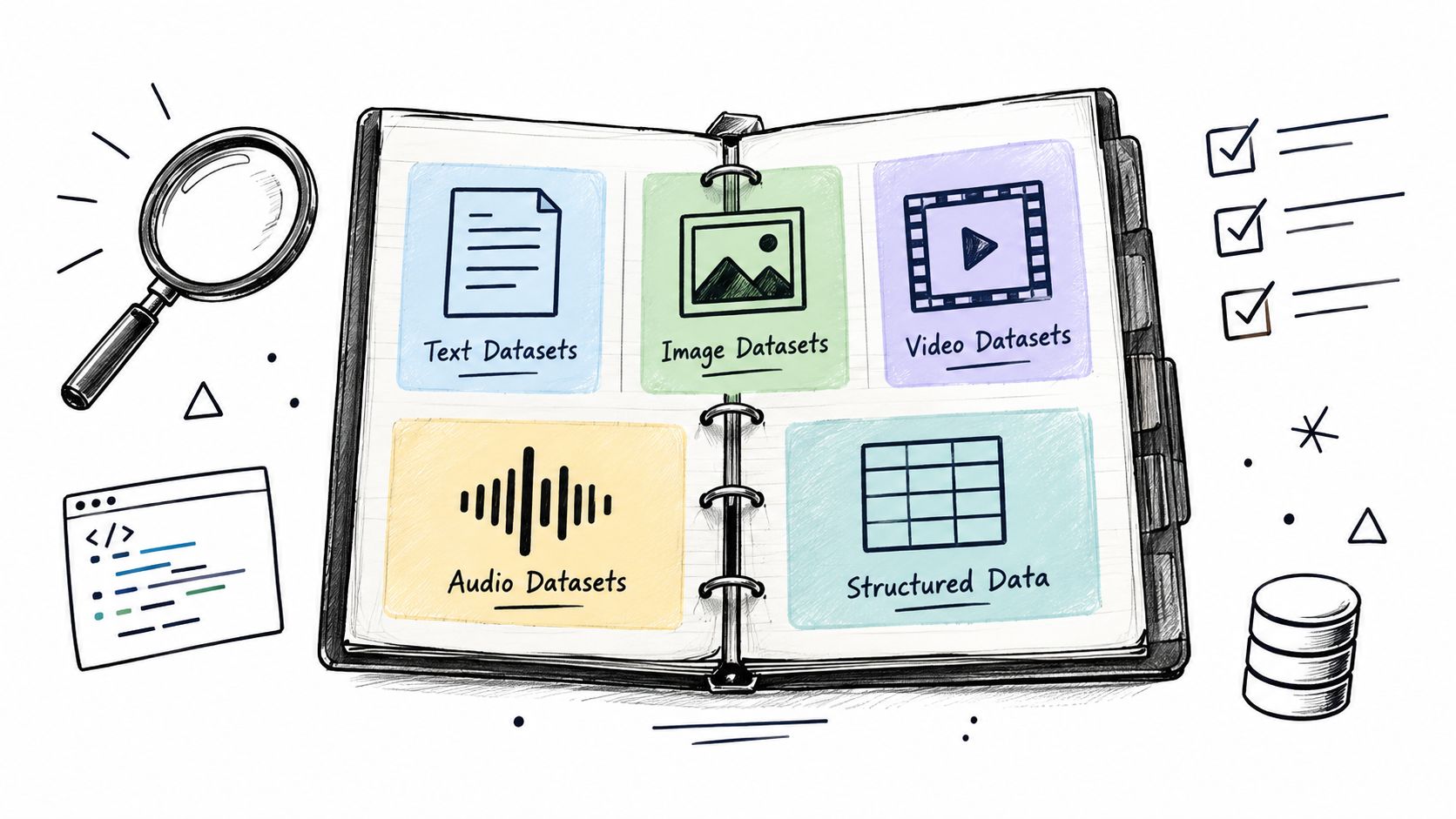
This list sorts machine learning datasets and dataset discovery platforms by modality, workflow, and the speed of getting from download to a trusted evaluation split. Each entry covers what the source contains, who it suits, what to verify before use, and how it supports an initial experiment. The practical question isn't which catalog has the most files. It's whether you can identify the data's origin, reproduce the preparation steps, freeze a defensible split, and use the resulting scores to make a decision.
Video and audio coverage is thinner here, so treat those entries as starting points rather than a complete map. Some platforms are excellent for finding data but weak at hosting it. Others make experimentation fast while leaving licensing and provenance checks to you. Use the list as a shortlist, then test candidates against your own held-out evaluation set before committing.
Table of Contents
- 1. SourceX
- 2. Google Dataset Search
- 3. Hugging Face Datasets Hub
- 4. Kaggle Datasets
- 5. Papers with Code Datasets
- 6. OpenML
- 7. UCI Machine Learning Repository
- 8. Data.gov
- 9. Registry of Open Data on AWS
- 10. Google Cloud Public Datasets
- 11. Roboflow Universe
- Comparison of 11 Machine Learning Dataset Sources
- Turn Your Shortlist Into a Benchmark You Can Trust
1. SourceX
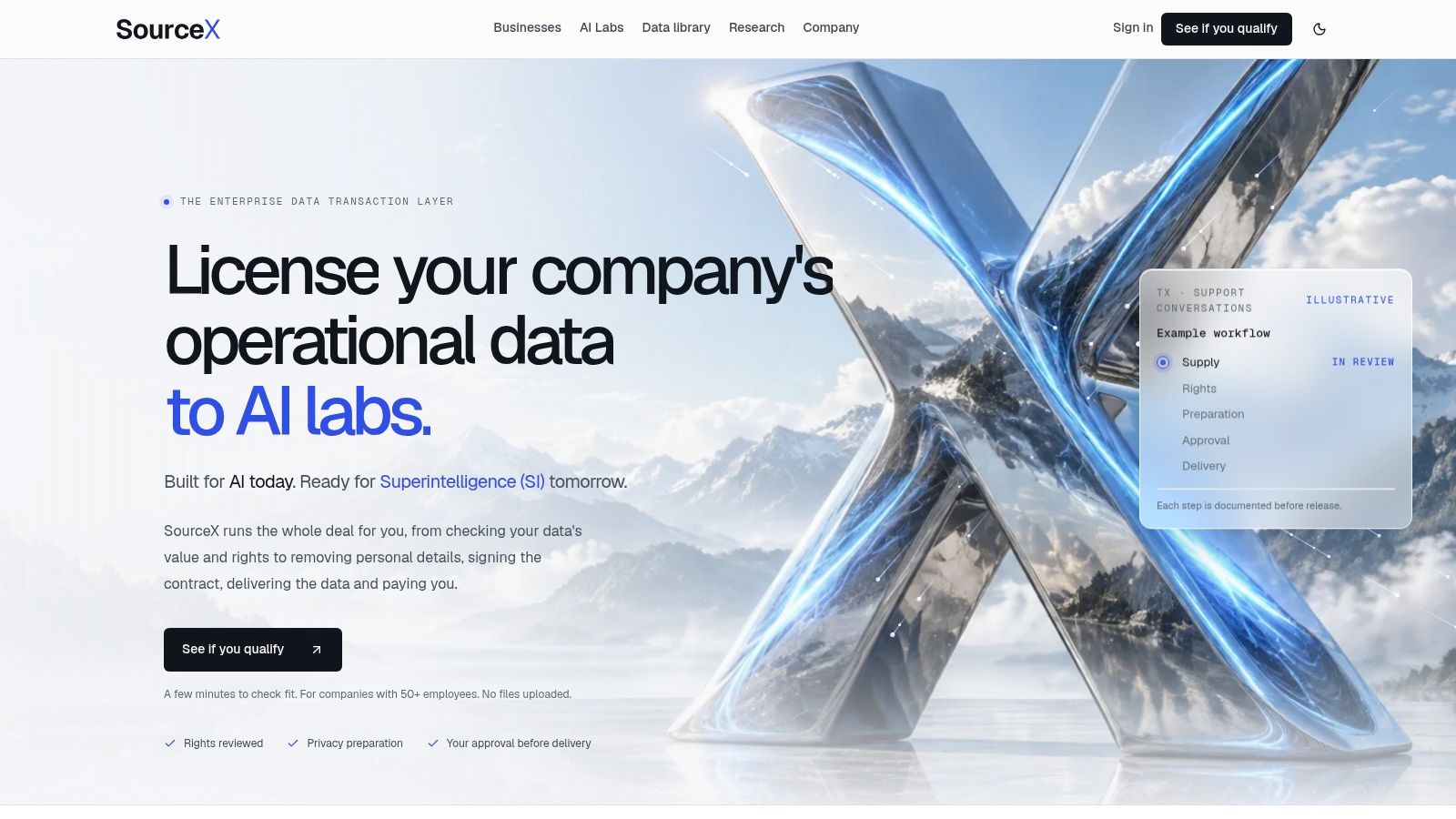
SourceX is different from a public dataset repository. It's an enterprise data transaction layer for companies that want to license operational data to AI labs and other buyers. That distinction matters when public downloads can't provide the domain detail, rights history, or privacy controls your project requires.
The workflow starts with a fit assessment that can estimate licensing potential without requiring an immediate upload. SourceX can then map data across business systems and years of history, creating a private inventory that describes sources, fields, depth, and availability. Supported exports can come from tools such as Zendesk, Salesforce, GitHub, Jira, SharePoint, and Google Workspace.
Why it helps with trusted evaluation
Messy operational records usually need more than a file conversion. They need provenance, rights review, privacy preparation, and a clear definition of the permitted use. SourceX handles those steps as part of one controlled workflow, with the supplier approving each stage before anything is shared.
The preparation is dataset-specific. Personal details can be removed, and the work is recorded before delivery. Suppliers confirm lawful collection and relevant licensing conditions, while the final evidence packet documents the system of origin, rights, intended purpose, and usage constraints.
Practical rule: A private dataset isn't evaluation-ready until you can explain where every field came from, which records were removed, and which uses the agreement permits.
SourceX also clarifies deal mechanics that are often vague in direct negotiations. Terms can include fixed-fee payments, selection windows, exclusivity periods, invoicing timelines, and permanent licensing conditions for selected data. The original supplier retains ownership of its underlying data, while the agreement defines how prepared data can be used.
Where SourceX falls short
This isn't the fastest option for a tutorial classifier or a quick benchmark reproduction. You'll need a real enterprise data need, internal authorization, and a willingness to work through legal and privacy review. It also doesn't replace your own data-quality testing. Deidentification can reduce privacy risk, but it doesn't guarantee representative labels, stable distributions, or a useful production split.
Choose SourceX when public datasets lack the operational context you need, when scraped data creates unacceptable legal exposure, or when your model requires proprietary records that can be licensed under explicit terms. If you need rights-cleared enterprise data with a documented path from source system to buyer delivery, request enterprise datasets through the platform.
2. Google Dataset Search
Google Dataset Search works best as a discovery layer. It searches dataset landing pages across repositories, government portals, academic publishers, and other web sources instead of keeping the files in one central warehouse. Use it when you're still asking, “What exists?” rather than, “Which hosted file should I train on?”
The search experience helps narrow results by format and update information where publishers provide that metadata. Results lead back to the hosting repository or canonical landing page, which is important for checking the original description, license, citation requirements, and version history.
Fast discovery, manual verification
The strength is breadth. You can search for a domain, modality, language, or subject and quickly find alternatives that aren't visible in a single repository. It's useful for comparing a government source with an academic mirror, or for locating the publisher's preferred version rather than downloading the first copy indexed elsewhere.
The weakness is metadata quality. Google Dataset Search depends on the information supplied by each publisher, so descriptions, update dates, formats, and licensing fields can be incomplete or inconsistent. It doesn't validate labels, remove duplicates, or guarantee that a result is still maintained.
Before downloading, open the original landing page and record the exact dataset version, source organization, license, file format, and stated split. Then inspect a sample for missing labels, duplicate identifiers, and unexpected fields that could leak the target.
Best use
Choose this source for a broad first pass across unfamiliar domains. It's especially valuable when you need to locate authoritative hosts or compare versions. Don't treat a search result as evidence that a dataset is safe, current, or evaluation-ready. The host's documentation and terms control your actual use.
3. Hugging Face Datasets Hub
The Hugging Face Datasets Hub is one of the strongest starting points for text, image, audio, video, tabular, geospatial, and time-series work. Its interface supports filtering by modality, task, language, license, and size, while the Datasets library gives you programmatic loading and streaming for large collections.
The browser preview is useful before you write a pipeline. You can inspect rows, filter examples, view basic distributions, and identify malformed records without pulling the full corpus locally. Dataset cards add provenance, intended-use guidance, limitations, and license tags, although maintainers don't document every project with the same care.
Strong tooling, uneven trust
The ecosystem integration is excellent. You can move from a dataset to models, Spaces, evaluation tools, and training scripts without changing platforms. Streaming also lets you inspect or process data without first storing the entire download.
That convenience can hide important differences between projects. Some datasets are gated. Others require acceptance of specific terms. Metadata may be incomplete, and a dataset card can describe intended use without proving that the labels are consistent or that the split is free of contamination.
A study of 6,758 datasets in the Hugging Face ecosystem found that only 1,925, or 28.48%, had dataset documentation. The remaining 71.52% lacked a dataset card, according to the dataset documentation study. Treat the card as a starting record, not a substitute for validation.
Practical workflow
Load a small slice first, inspect the schema, verify label names, and search for duplicate or near-duplicate examples. Save the revision identifier and card contents with your experiment. If your workflow also compares local language models, this Ollama versus llama.cpp guide can help you separate dataset problems from runtime choices.
Choose Hugging Face when you need modern multimodal tooling and fast experimentation. Choose something else when your main requirement is a centrally governed, uniformly documented corpus.
4. Kaggle Datasets
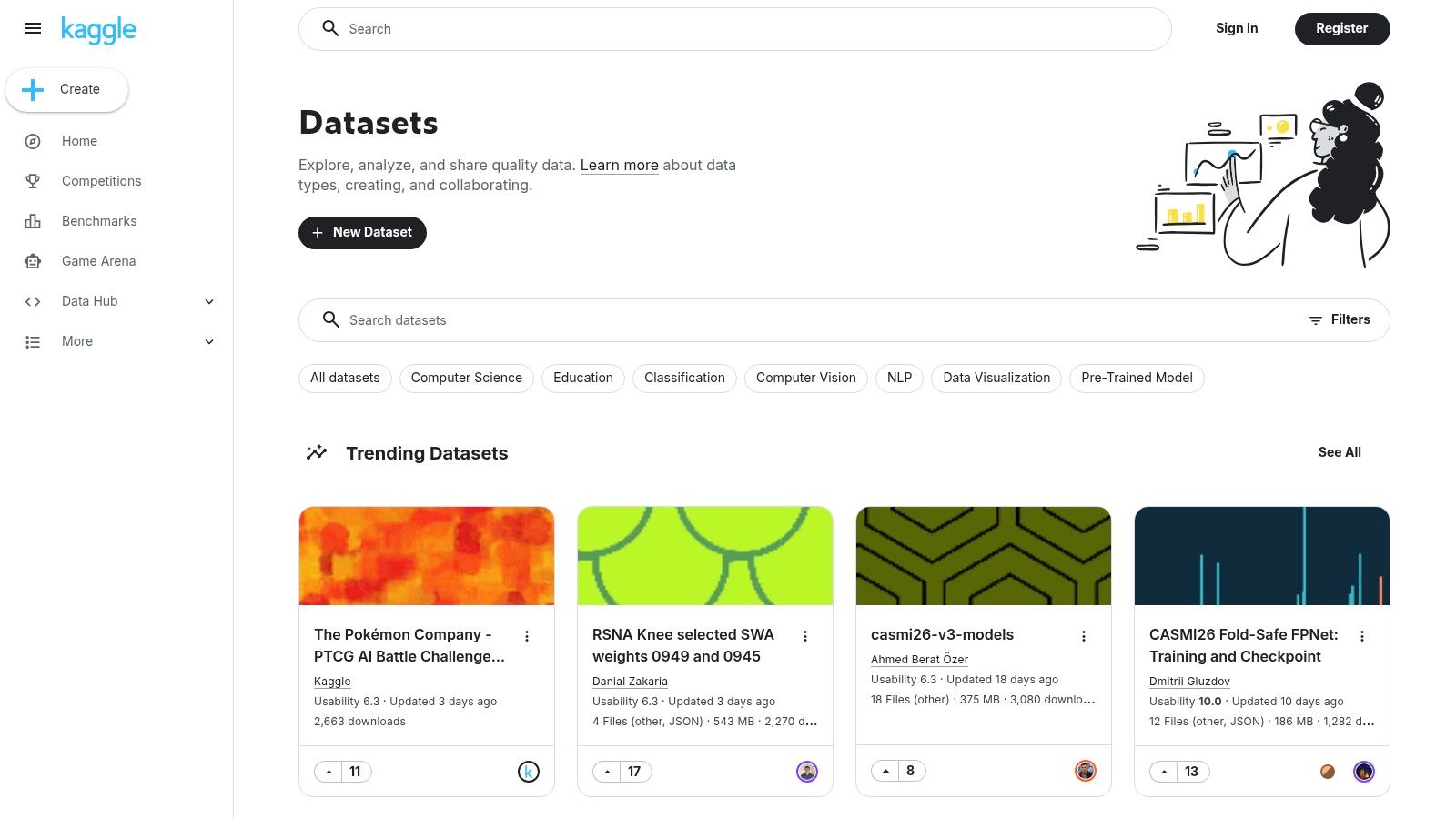
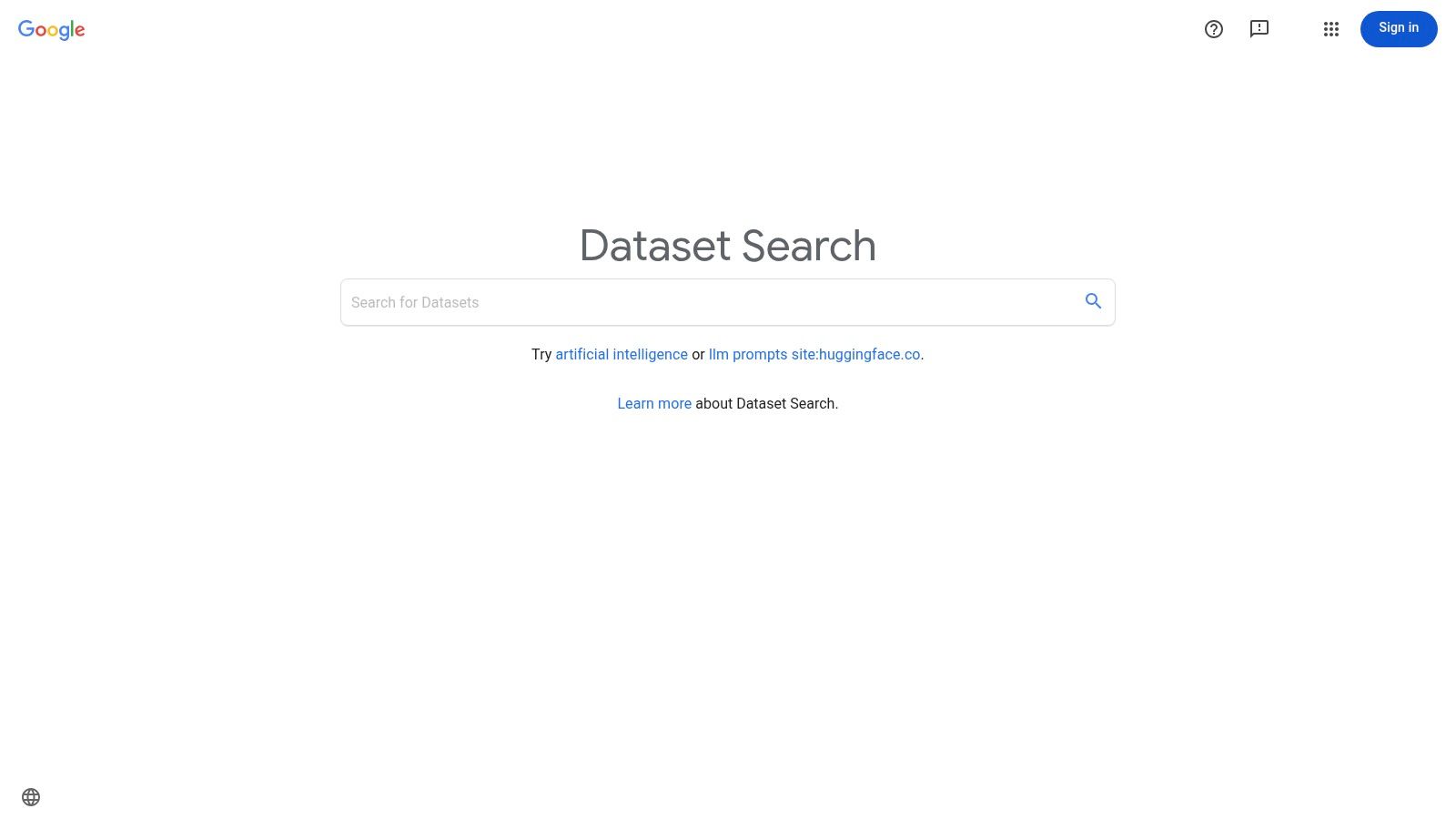
Kaggle Datasets is built for low-friction experimentation. The catalog spans tabular, text, image, audio, and time-series data, and many entries connect directly to notebooks, competitions, discussions, and community examples. That makes it easy to find a working baseline before you design a polished pipeline.
The hosted notebook environment is the main advantage. You can open an example, inspect the files, run a baseline, and use the Kaggle CLI to script downloads later. Search filters cover file type, tags, size, and license, while dataset pages often expose version information and community feedback.
Excellent for prototypes
Kaggle is particularly effective for teaching, hackathons, and early model comparisons. Community notebooks reveal common cleaning steps and failure modes faster than a blank repository does. Competitions can also provide a defined target and evaluation convention, which helps you get to a first score quickly.
The trade-off is inconsistency. Community uploads differ in documentation, provenance, labels, and maintenance. A familiar dataset name doesn't guarantee that a particular copy is canonical. Licenses also vary by dataset, so you need to read the individual terms rather than assume that public visibility permits commercial use or redistribution.
Use the notebook as exploration, then move the pipeline into version-controlled code. Download the exact version, create your own validation split, and check whether notebook preprocessing uses information from the test data.
A fast notebook is a prototype, not a governance record.
Kaggle is the right choice when speed and examples matter most. It's less suitable as the sole source for a regulated production system unless you independently verify provenance, rights, and data quality. For workflows involving personal exports, this guide to extracting and analyzing ChatGPT history is a useful adjacent reference, but it doesn't replace a dataset-specific privacy review.
5. Papers with Code Datasets
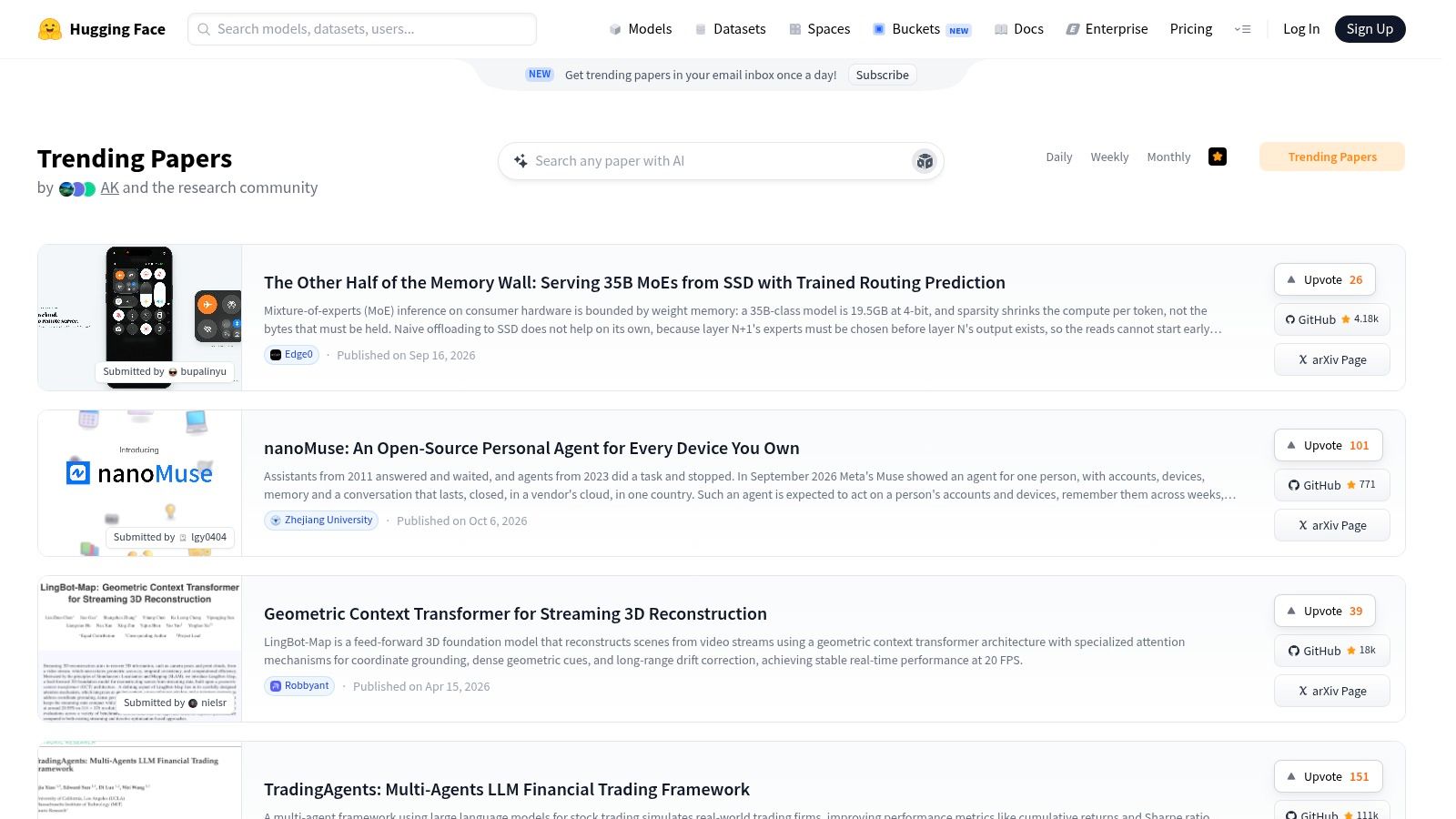
Papers with Code's dataset index is a research navigation tool rather than a storage platform. It connects datasets to tasks, papers, reported results, leaderboards, and related implementations. That context can save time when you need to reproduce a benchmark instead of just finding a downloadable file.
Start with the task and follow the links to the dataset's canonical host. The surrounding papers can reveal the expected input format, standard metrics, baseline models, and commonly used splits. Those details are often more valuable than a polished repository page because they show how researchers evaluate the data.
Benchmark context is the product
The index helps identify de facto standard versions and exposes reported performance in a shared task context. Community-editable pages and exports make it useful for building a research inventory or tracking which datasets repeatedly appear in a field.
It isn't a quality guarantee. The index links outward, so licenses, file integrity, maintenance, and access conditions belong to the host. Coverage can also be shallow in specialized domains. A leaderboard score may use a split or preprocessing step that doesn't match your intended deployment.
Before you compare results, read the source paper and the dataset page. Record the split definition, preprocessing assumptions, metric implementation, and attribution requirements. Then reproduce one baseline on the exact version you plan to use.
If you're comparing generative models rather than classic task metrics, this Claude Sonnet and GPT comparison illustrates why identical inputs and consistent scoring matter. Papers with Code is best when reproducibility and benchmark lineage are your priorities, not when you need one-click production data delivery.
6. OpenML
OpenML is a practical choice for tabular experiments, algorithm comparisons, and AutoML workflows. Its value comes from structure. Dataset metadata, programmatic loaders, and defined tasks make it easier to reproduce an experiment than a loose folder of CSV files.
Search filters expose properties such as instance count, feature count, format, and tags. An OpenML task can also specify the target and split used for an experiment. That creates a shared reference point when you're comparing preprocessing pipelines, estimators, or hyperparameter searches.
Good for controlled comparisons
OpenML reduces the setup work that often derails small benchmarking projects. Python, R, and Java APIs let you retrieve datasets and tasks directly from code. You can keep the task identifier with your experiment and avoid changing the target column or split between runs.
The platform leans toward classic machine learning and tabular data. It isn't the best place to search for massive multimodal corpora, contemporary instruction data, or specialized video resources. Some older entries also have limited documentation, so a defined task doesn't automatically explain how the source data was collected or whether its labels reflect your population.
Run a schema inspection before training. Check missing values, categorical encodings, duplicated rows, and whether the target appears in a derived feature. For time-dependent data, confirm that the task's split respects chronology instead of randomly mixing future records into training.
OpenML is the right starting point when your question is, “Which pipeline performs better under the same task definition?” It's less useful when your main challenge is sourcing new domain data or negotiating usage rights.
7. UCI Machine Learning Repository
The UCI Machine Learning Repository remains a dependable first stop for teaching, demos, and compact tabular experiments. Its familiar collections, including Iris, Adult, and Wine, are easy to download and import into a notebook. Descriptions are usually concise, with basic citation information and straightforward file access.
That simplicity is the point. A student can focus on feature handling, classification, regression, clustering, or evaluation without first learning a complex storage API. An instructor can demonstrate preprocessing with a dataset that fits comfortably into a local workflow.
Simple does not mean production-ready
UCI is not where you'll usually find large modern multimodal data or rich experiment tracking. Metadata depth and tooling are lighter than on newer hubs. Some datasets need careful interpretation because the documentation may not cover the assumptions you'd want for a production model.
The repository is useful for learning how a split affects a score, but classroom benchmarks can produce false confidence. Small datasets may not represent the noise, drift, missingness, or subgroup variation that your application will encounter. Use them to test code and concepts, not to estimate deployment performance.
Before training, read the attribute descriptions and identify fields that encode the outcome indirectly. Save the original archive, note the repository citation, and write your own data dictionary. If the dataset has no supplied split, create one with a fixed seed and document the decision.
Choose UCI when you need an approachable, stable teaching example. Don't choose it because a familiar dataset makes a model look ready for real users.
8. Data.gov
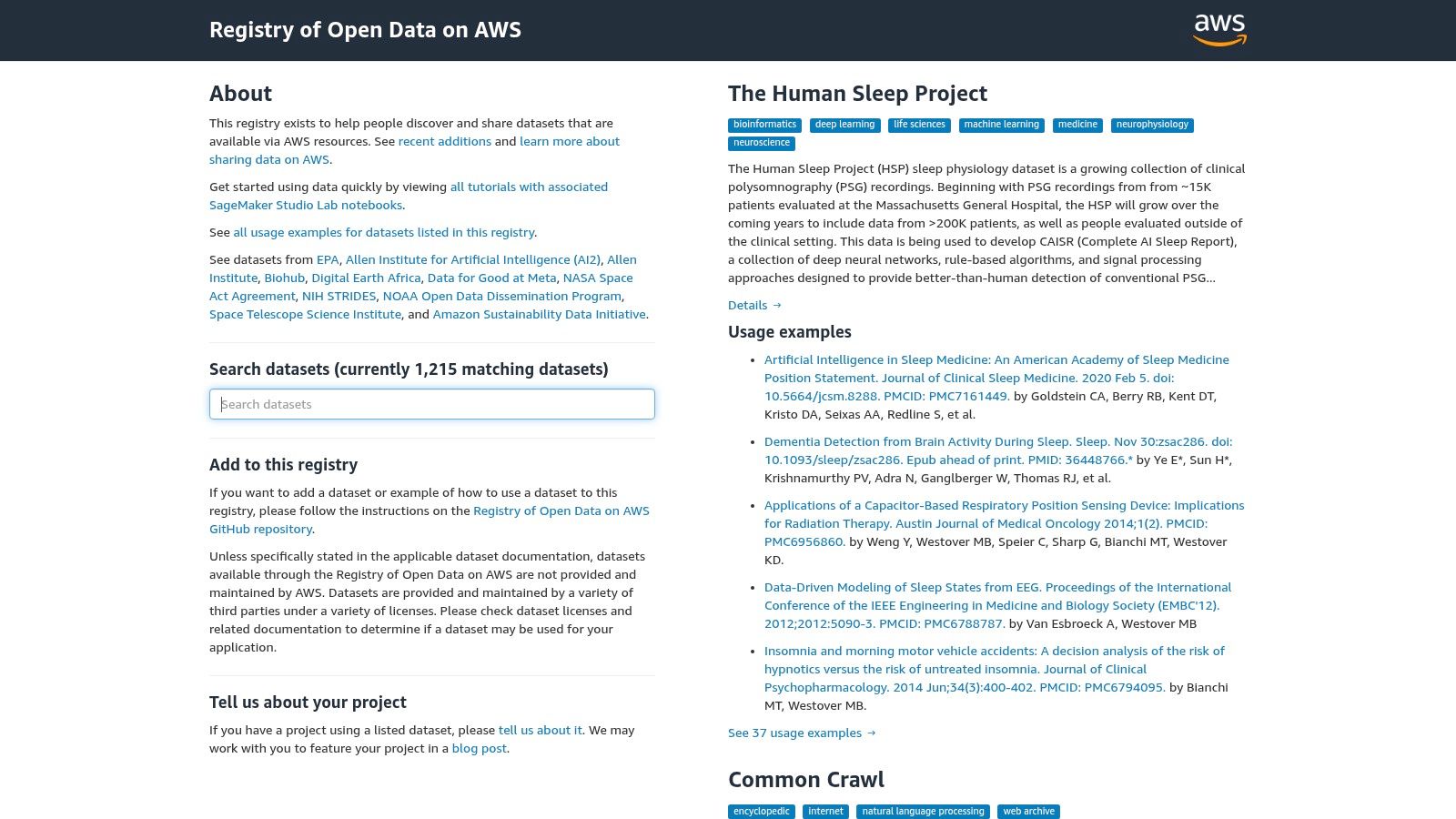
Data.gov is a strong source for real-world public data from United States federal, state, and local agencies. Its catalog covers business, economic, health, climate, policy, and geospatial topics. The catalog API helps you discover resources programmatically, while the landing pages usually identify the contributing agency and source system.
The main benefit is authority and operational relevance. A government dataset can reflect the kind of messy, changing records that production systems encounter. Many entries include update information, documentation, and links to the agency responsible for maintenance.
Plan for preprocessing
Data.gov isn't an ML-specific repository. Formats, naming conventions, field definitions, and update practices vary across agencies. Some records are clean enough for immediate analysis. Others require substantial work around geographic identifiers, date parsing, missing values, changing schemas, and joins across releases.
Links may point off-site, so the catalog entry is only part of your audit trail. Open the original agency page, check the license and terms, and record the release date or update marker. If you're building a recurring training job, test whether the source changes columns or revises historical records without preserving old versions.
A useful first slice should include more than random rows. Sample across time, geography, and relevant categories so you can see whether the label distribution changes. Build your validation set around the way the model will be used, not around the easiest random split.
Choose Data.gov when your model needs public-sector or policy-relevant data and you can budget for cleaning. It's a poor fit for instant deep-learning experimentation, but a strong fit for practitioners who need realistic public records and traceable source agencies.
9. Registry of Open Data on AWS
The Registry of Open Data on AWS provides public datasets hosted in Amazon S3 and related AWS services. It's particularly useful when your training or analytics pipeline already runs on AWS and you want cloud-native access rather than downloading a large archive to a laptop.
Registry entries commonly provide direct S3 or HTTP access, usage examples, change information, and notes about the dataset. Many resources use formats designed for analytical access, including Parquet and cloud-optimized geospatial formats. That can make filtering and streaming more efficient than processing a single compressed file.
Scale still has a bill
Public access doesn't mean zero operational cost. You may pay for compute, and some S3 resources use requester-pays access. Storage, transfer, feature extraction, and repeated scans can also become material parts of the workflow. Estimate the full pipeline before treating a public bucket as a free training source.
Common Crawl shows the scale available through cloud-hosted public data. Its project began collecting open web data in 2008, has accumulated more than 10 petabytes, and releases crawls approximately monthly, with each release typically containing more than two billion web pages, according to the Common Crawl archive overview. Those figures make filtering, deduplication, safety review, copyright analysis, and provenance essential parts of the job.
Start by querying metadata or a narrow partition. Inspect schemas, count nulls, identify duplicate keys, and verify that the license supports your intended use. Don't copy the whole corpus just because the storage layer makes it accessible.
Choose AWS's registry when your team already uses Athena, SageMaker, EMR, or S3-based pipelines. It's less convenient for a small local prototype and less forgiving when your cloud budget or governance process is limited.
10. Google Cloud Public Datasets
Google Cloud Public Datasets is designed for structured analysis in Google Cloud, especially through BigQuery. The ability to query hosted data with SQL before ingesting it changes the first step. You can inspect distributions, join sources, test feature logic, and estimate data usefulness without building a download pipeline first.
The catalog connects with BigQuery, Vertex AI, Dataflow, and hosted notebooks. Documentation and schemas are usually clearer than what you'll find in an arbitrary file mirror, which helps you establish a reproducible first query and understand field types before exporting training data.
SQL-first evaluation
Use SQL to create a profiling query before selecting rows for training. Check missingness, date coverage, category frequency, duplicate identifiers, and suspicious relationships between input fields and the target. Export only the columns and records you can justify, then record the query text alongside the dataset snapshot.
The trade-off is billing. Query costs apply beyond the free tier, and sustained use requires Google Cloud billing. A public dataset can therefore be cheap to inspect but expensive to scan repeatedly, especially when your query ignores partitioning or reads unnecessary columns.
Cloud hosting also doesn't settle the license question. Read the dataset-specific terms and confirm whether the allowed use covers model training, redistribution, commercial deployment, and derived outputs. A clean schema can reduce engineering friction, but it doesn't provide consent or representativeness.
Choose Google Cloud Public Datasets when your team wants SQL exploration, structured records, and direct integration with Google's ML stack. Choose a file-based repository when local reproducibility and predictable offline access matter more than cloud-native analysis.
11. Roboflow Universe
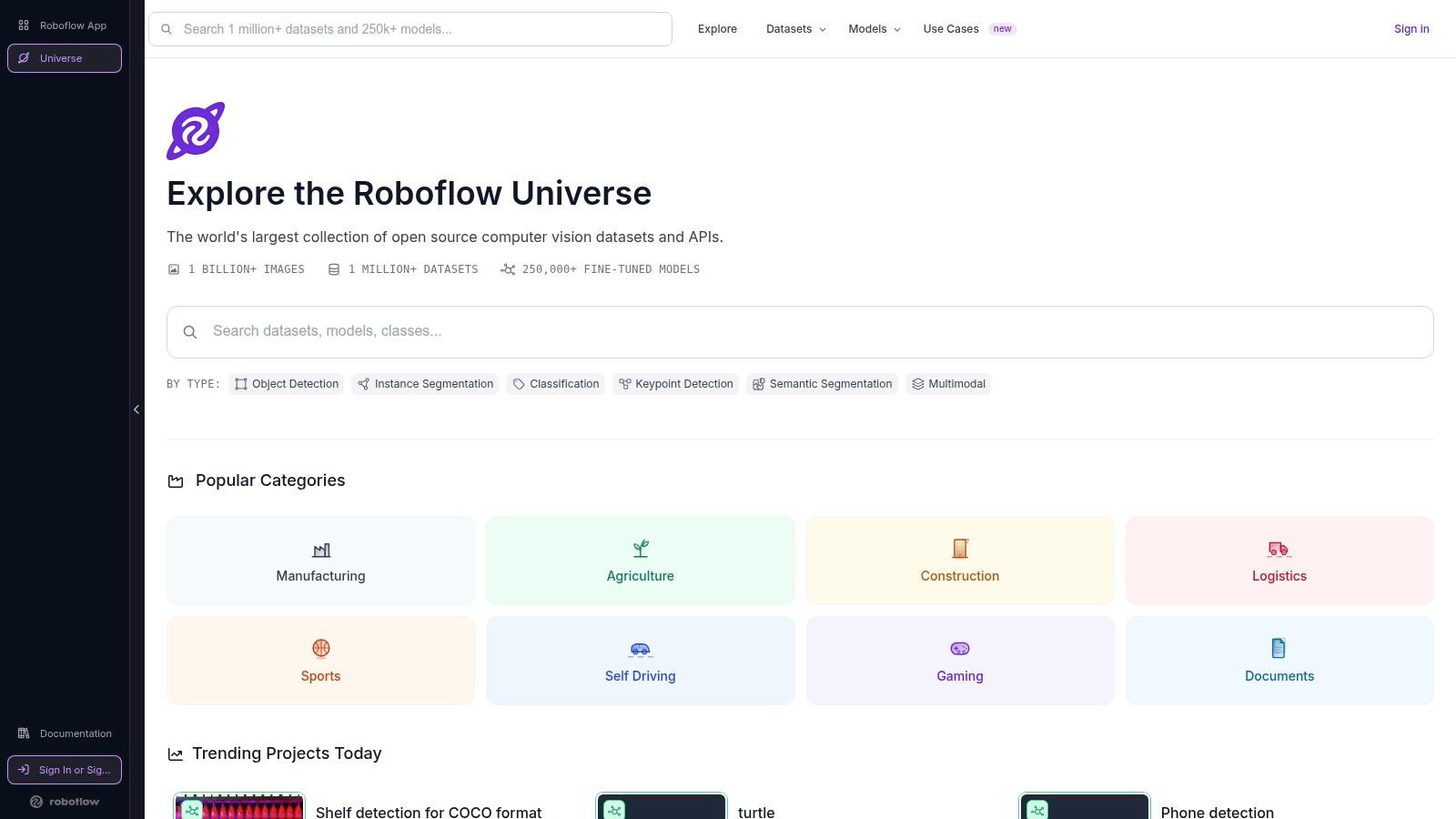
Roboflow Universe is the most specialized entry here. It focuses on computer vision datasets and pretrained models, with practical tools for browsing classes, previewing images, forking projects, auto-labeling, augmenting, and exporting to formats such as YOLO and COCO.
For a detection or segmentation prototype, that workflow is fast. You can inspect class lists and example images in the browser, review community activity, and export into a training format without writing every conversion script yourself. One-click training and annotation tools can shorten the path from an idea to a working baseline.
Inspect labels, not just images
Vision datasets often fail through annotation problems rather than missing files. Check whether bounding boxes fit the objects, whether class definitions overlap, whether difficult examples are absent, and whether near-identical frames appear across train and test. A visually attractive preview doesn't prove that the labels support your deployment conditions.
Licenses vary by project and must be checked individually. Community statistics such as views, downloads, and stars can help you prioritize inspection, but popularity isn't permission and it isn't a quality audit. Confirm whether the images can be used commercially and whether attribution or share-alike requirements apply to the dataset or derived work.
Create a held-out set from the same camera types, locations, and object conditions you expect in production. If the public dataset comes from a different environment, use it for pretraining or prototyping and evaluate separately on your own images.
Roboflow Universe is the right choice for rapid computer vision exploration. It's not a general-purpose dataset source, and you shouldn't treat its export convenience as a substitute for label review, provenance checks, or domain-specific validation.
Comparison of 11 Machine Learning Dataset Sources
| Platform | Core focus | Best for 👥 | Access / Price 💰 | Quality & standout ★ ✨🏆 |
|---|---|---|---|---|
| SourceX | Enterprise data licensing, rights, deidentification, delivery | 👥 Enterprises & AI labs needing rights-cleared operational data | 💰 Custom / fixed-fee deals; contract terms (Net60 etc.) | ★★★★★ 🏆 Supplier-approved workflows & evidence packets ✨ |
| Google Dataset Search | Federated dataset discovery via schema.org across the web | 👥 Researchers & discoverers looking for canonical hosts | 💰 Free to use; source hosting may vary | ★★★★ Broad coverage; ✨ federated indexing |
| Hugging Face Datasets Hub | Multimodal community & org datasets with programmatic loaders | 👥 ML engineers & researchers prototyping generative models | 💰 Free/community; some gated or licensed sets | ★★★★★ 🏆 Strong model/hub integration; ✨ dataset cards & streaming |
| Kaggle Datasets | Community datasets + hosted notebooks, competitions, API/CLI | 👥 Students, competitors, rapid prototyping teams | 💰 Free (community-hosted) | ★★★★ Active community & reproducible notebooks ✨ |
| Papers with Code, Datasets | Curated index linking datasets to papers, leaderboards, metrics | 👥 Researchers seeking benchmarks & SOTA comparisons | 💰 Free directory | ★★★★ Helpful for reproducible research; ✨ paper+leaderboard context 🏆 |
| OpenML | ML-ready datasets, uniform metadata, defined tasks & APIs | 👥 AutoML researchers & algorithm benchmarkers | 💰 Free access; programmatic APIs | ★★★★ Reproducible tasks & consistent metadata ✨ |
| UCI Machine Learning Repository | Classic academic tabular datasets for teaching/research | 👥 Educators, students, quick demos | 💰 Free downloads (CSV/ARFF) | ★★★ Time-tested benchmarks; ✨ very low friction |
| Data.gov (US) | Aggregated authoritative public data from federal/state/local agencies | 👥 Policy analysts, businesses needing authoritative sources | 💰 Free; data hosted by agencies | ★★★★ Authoritative sources & APIs; ✨ stable update cadence |
| Registry of Open Data on AWS | Public datasets hosted/optimized for AWS (S3, Parquet) | 👥 Engineers training at scale on AWS services | 💰 Free hosting; pay for AWS compute/bandwidth | ★★★★ Cloud-optimized corpora; ✨ direct S3 access 🏆 |
| Google Cloud Public Datasets (BigQuery) | Curated public datasets with first-class BigQuery access | 👥 Analysts & teams needing SQL-at-scale on GCP | 💰 Free catalog; BigQuery query costs apply | ★★★★ Instant SQL exploration; ✨ BigQuery & Vertex AI integration |
| Roboflow Universe | Community CV datasets, auto-annotation, export & training tools | 👥 Computer vision practitioners prototyping detection/segmentation | 💰 Free community tier; paid features for pipelines | ★★★★ Practical CV tooling; ✨ auto-label/export + one-click training |
Turn Your Shortlist Into a Benchmark You Can Trust
Start with two or three sources that match your modality and operating constraints. A public catalog can help you discover candidates, while a cloud registry or hosted hub may make experimentation faster. For proprietary operational data, a licensing workflow may be more appropriate than adapting a public dataset that lacks the rights or domain context you need.
Read the license on each individual dataset before downloading it. Don't infer permission from the repository, the file format, or the fact that a dataset is publicly visible. Check commercial use, redistribution, attribution, derivative works, privacy conditions, and any restrictions on model training. If the terms are unclear, record that uncertainty as a blocker instead of moving forward without flagging the issue.
Freeze your train, validation, and test split before comparing models. Record the dataset version, source URL, preparation code, schema, and checksum. For time-dependent or user-dependent data, use a split that matches the production failure mode. Random splitting can make a model look stronger when related records, users, sessions, or future events appear in both training and evaluation.
Documentation deserves the same attention as the files. Data Cards recommend recording upstream sources, collection and annotation methods, intended use, evaluation procedures, and known limitations. A documented dataset still may be biased or incomplete, but missing documentation increases the work required to audit, reproduce, and defend your results.
Synthetic data deserves a controlled test, not automatic trust. Research on synthetic augmentation finds that it can't improve generalization to a target population unless it contributes information that complements the original data. Without target-domain validation data, you can't reliably determine whether it helps or harms performance. Evidence from multilingual NLP also reports that purely synthetic data performed worse than an equal amount of human data across tested datasets, with the amount of human data needed for gains differing by language, as described in the synthetic data research.
For model comparison, send identical prompts or inputs from your held-out set through AI4Chat's Playground and review responses side by side. Score outputs with metrics that reflect your task, then inspect failures manually. AI4Chat provides a browser-based workspace for comparing generative models across chat and other creative modalities, which can reduce context switching during evaluation. Its AI model comparison platform is most useful here as an evaluation interface, not as a replacement for dataset governance.
Treat public benchmark numbers as proxies. Your production data will differ in wording, image conditions, missing fields, user behavior, and edge cases. The useful result isn't the highest public score. It's a repeatable comparison showing which system performs best on the data your users will provide, under terms your organization can defend.
Pick one candidate today, download only a small slice, and write the first schema and license record before training. If the source survives that check, create a fixed evaluation split and compare your baseline in AI4Chat's Playground using identical inputs. That process will tell you more about production fit than another round of browsing dataset leaderboards.