
A practical starting range for skilled virtual-assistant roles in Latin America is $9.00 to $12.41 per hour, but the right rate depends on the country, specialization, language requirements, schedule, and level of judgment involved. A dispatcher may sit near the lower end, while an SDR or BDR can command the higher end in one 2026 placement dataset.
You're probably not looking for the cheapest person who can answer email. You need someone who can work during the right hours, understand your customers, update the CRM without supervision, and know when a request needs a human decision. That's why hiring across Latin America works best as a country-by-country fit exercise, not as a race to find the lowest hourly quote.
The strongest decisions balance dialect, time-zone overlap, role-specific skill, data protection, and management capacity. A bilingual customer-support assistant in Mexico may suit a Pacific Time team better than a highly skilled candidate in the Southern Cone. A Brazilian Portuguese specialist may be the right choice for a local market, even when a Spanish-speaking candidate appears cheaper. A hybrid workflow may also outperform either a fully manual assistant or an unmanaged AI tool.
Table of Contents
- Why Latin America Fits Modern Remote Teams
- Choosing Between Agencies, Freelance Platforms, and Direct Hiring
- How to Vet Latin American Virtual Assistants Without Wasting Time
- How LatHire Can Help
- Onboarding Remote Assistants for Real Productivity
- Using AI Tools Alongside Human Assistants
- Pricing, Contracts, and Cross-Border Compliance Basics
- Common Mistakes That Sink Virtual-Assistant Hires
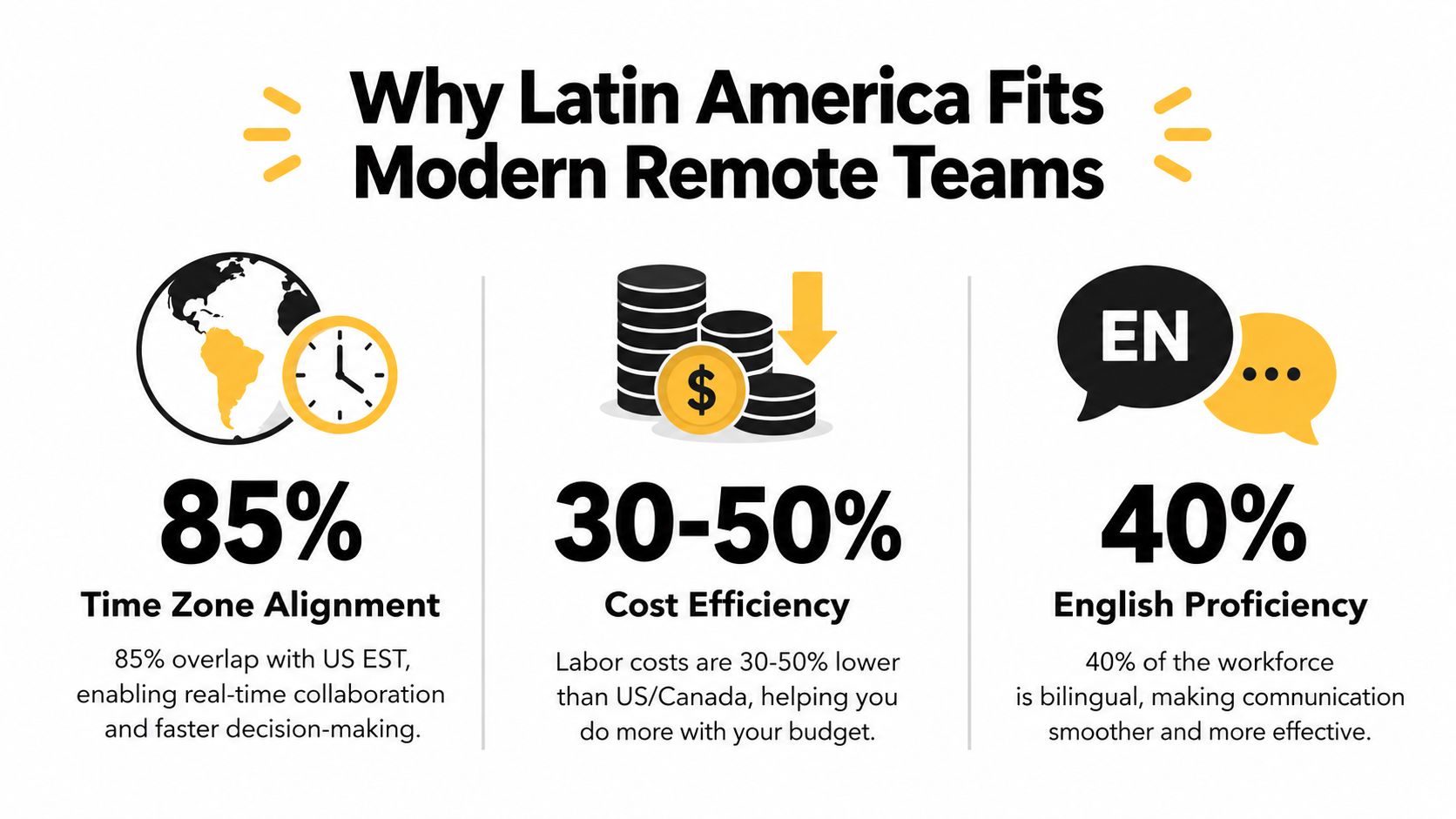
Why Latin America Fits Modern Remote Teams
A U.S. software company hires an assistant to manage support tickets, prepare sales follow-ups, and keep the founder's calendar moving. The first shortlist looks attractive because the candidates are affordable. Then the practical questions arrive: Who can join a customer call at the required hour? Who can write naturally to customers in English and Spanish? Who understands the difference between a routine request and a sensitive account issue?
Those questions decide the hire. Latin America offers geographic proximity to North America, overlapping business hours, and substantial experience with messaging-first customer service. But the region isn't a single labor pool. Country, language, role, and workflow must be specified together.
The early enterprise pattern is visible in financial services. A 2021 Frost & Sullivan study commissioned by Infobip found that 21% of financial institutions in Latin America were already using automated virtual assistants or AI chatbots, compared with 13% in the United States. The same research reported that 34% of regional institutions used chat applications such as WhatsApp for customer interactions, while 28% used virtual telephone assistants or interactive voice response systems. The regional banking adoption findings show why assistants in the region developed around practical service workflows rather than abstract experimentation.
The region is broader than administrative support
Modern demand extends beyond calendar management and inbox cleanup. Companies hire across customer support, sales development, bookkeeping, marketing, design, and software development, according to the 2026 placement data referenced in the hiring research. That matters because the evaluation standard changes with the role. A bookkeeping assistant needs accuracy and financial process discipline. An SDR needs spoken confidence, objection handling, and CRM hygiene. A content assistant needs editorial judgment and cultural fluency.
The rate range reflects that difference. The same dataset placed median client-side rates between $9.00 per hour for dispatchers and $12.41 for SDR/BDR roles. The placement dataset and role comparison support a simple conclusion: specialization often matters more than geography.
Brazil and Mexico are important reference markets for different reasons. In the banking research, WhatsApp served bank customers at 98% of Brazilian institutions and 97% of Mexican institutions, exceeding the role of physical agents in those markets. That history helps explain why messaging, conversational support, and automation are familiar operating patterns in the region.
Practical rule: Choose the country after defining the workday, language mix, and decision burden. A low hourly rate can't compensate for poor customer communication or an unsustainable schedule.
A useful shortlist therefore starts with the operating problem. For live Eastern Time support, assess candidates who can sustain that schedule without forcing an awkward local shift. For Pacific Time coverage, prioritize countries with a natural overlap before comparing broader talent pools. For asynchronous research, documentation, and content production, widen the geography and focus more heavily on writing, process discipline, and review quality.
Choosing Between Agencies, Freelance Platforms, and Direct Hiring
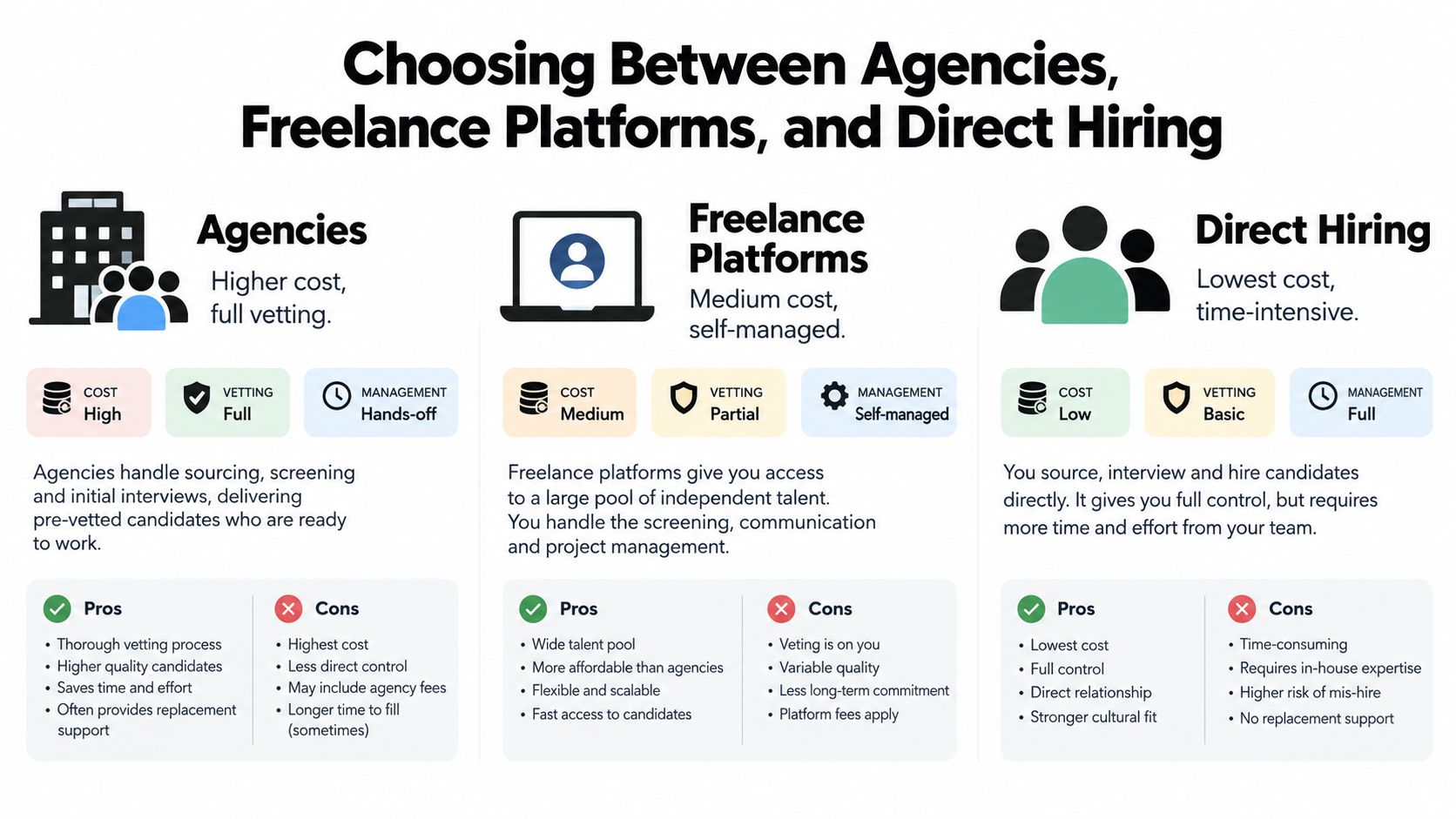
The sourcing channel changes the work you must perform. An agency reduces administrative effort but adds a margin. A freelance platform gives you a broad market but leaves screening, contracts, and continuity largely in your hands. Direct hiring can produce the strongest long-term fit, yet it requires the clearest role definition and the most operational preparation.
Agencies
An agency suits a company that needs speed, structured vetting, or cross-border administration. The better providers test language, role skills, availability, and references before presenting candidates. Some also handle contracts, payroll, benefits, replacement support, and compliance coordination.
The trade-off is less price transparency and less direct control over the employment setup. Ask whether the quoted rate includes management, payroll, benefits, replacement coverage, and currency or payment handling. Also ask what happens if the assistant is technically capable but wrong for your communication style.
Agencies work especially well for customer-facing roles, regulated workflows, and companies hiring in a country where they lack local counsel. They're less compelling when you already have a reliable recruiting process and only need a narrowly defined freelance project.
Freelance platforms
Platforms are useful when the task is bounded and the manager can screen independently. A company might use one to find a designer for a campaign, a researcher for a defined project, or an assistant for a limited schedule. The entry process is usually straightforward, and the candidate pool is broad.
The hidden cost is evaluation time. You must verify identity, language ability, availability, work history, references, payment arrangements, and data handling. Platform ratings can help, but they rarely show how someone responds to changing priorities, sensitive customer information, or repeated feedback.
Use a paid, realistic trial rather than relying on a polished profile. A candidate who claims to manage a CRM should clean duplicate records and document the change. A customer-support candidate should respond to a difficult scenario in the required language and tone.
Direct hiring
Direct hiring gives you the most control over compensation, workflow design, tools, and long-term team integration. It can be the right model when you have internal recruiting capacity, local legal support, and a manager who can run a disciplined onboarding process.
It also transfers the administrative burden to you. Worker classification, local labor norms, tax documentation, payment, confidentiality, intellectual-property ownership, and offboarding all need attention. A low direct rate may look attractive until finance and operations spend substantial time coordinating the engagement.
| Sourcing path | Best fit | Main advantage | Main risk |
|---|---|---|---|
| Agency | Urgent or cross-border hiring | Managed vetting and administration | Added cost and less control |
| Freelance platform | Defined projects and flexible capacity | Broad choice and easy access | Variable reliability and screening burden |
| Direct hiring | Long-term roles with internal support | Maximum operational control | More legal and management responsibility |
For teams that need to compare hiring channels alongside broader marketing staffing options, this marketing job board resource can help frame the decision. The important question isn't which channel advertises the lowest rate. It's which channel leaves you with the right amount of work after the hire is made.
How to Vet Latin American Virtual Assistants Without Wasting Time
A résumé can show experience, but it can't prove that a candidate will write clearly to customers, handle a live call, or protect a sensitive workflow. Vetting should resemble the job itself. The shorter and more realistic the assessment, the faster you'll see whether the candidate can perform without constant correction.

Start with the operating profile
Write the role before reviewing candidates. Include the recurring tasks, required tools, working hours, customer language, escalation rules, and definition of acceptable quality.
“Administrative assistant” is too broad to evaluate. “Manage calendar changes, prepare a daily agenda, update the CRM, and escalate conflicts on the same business day” gives you a testable profile. It also lets candidates decide whether the role matches their strengths.
Screen the schedule early. Ask candidates to confirm their availability for the exact live window, including seasonal changes in your own time zone. An assistant who can technically work the hours but dislikes the schedule is a retention risk.
Test language in the form the job requires
Written and spoken fluency aren't interchangeable. A candidate may write polished emails but struggle to summarize a fast customer call. Another may speak comfortably but produce inconsistent written records.
Use a short email exercise based on a realistic customer or executive situation. Then run a live conversation in English, Spanish, or Portuguese as required. Ask the candidate to explain a process, summarize a scenario, and respond when priorities change.
Voice systems need even more careful testing. A benchmark using more than 200 hours of human-verified real-world audio reported a 7.85% word-error rate for Argentinian Spanish versus 16.04% for Venezuelan Spanish, while Brazilian Portuguese error rates reached 18.8% for long gaps exceeding 150 seconds, compared with 12.4% for shorter pauses. The dialect-specific voice benchmark demonstrates why a single regional accuracy score can conceal serious weaknesses.
Use task proof instead of personality signals
Give shortlisted candidates a short paid trial. Match it to the role:
- Calendar support: Resolve a scheduling conflict, identify missing information, and draft the confirmation.
- Customer service: Respond to a frustrated customer, classify the issue, and identify the escalation point.
- Sales development: Research a prospect, write a short outreach message, and log the activity in a sample CRM.
- Bookkeeping support: Organize provided transactions and flag ambiguous entries without guessing.
- Content operations: Turn a source document into a brief, draft, metadata fields, and a review checklist.
Observe how the candidate asks questions. Strong assistants don't hide uncertainty. They isolate it, explain what they need, and keep the rest of the work moving.
For teams exploring automation during screening, this guide to conversational AI in recruitment provides useful context. Automation can sort applications and standardize initial questions, but a manager should still verify communication, judgment, and task quality personally.
Finish with references that test consistency, not charisma. Ask former managers what the candidate owned, how they handled feedback, and whether they needed repeated reminders. Those answers usually reveal more than a list of software tools.
How LatHire Can Help
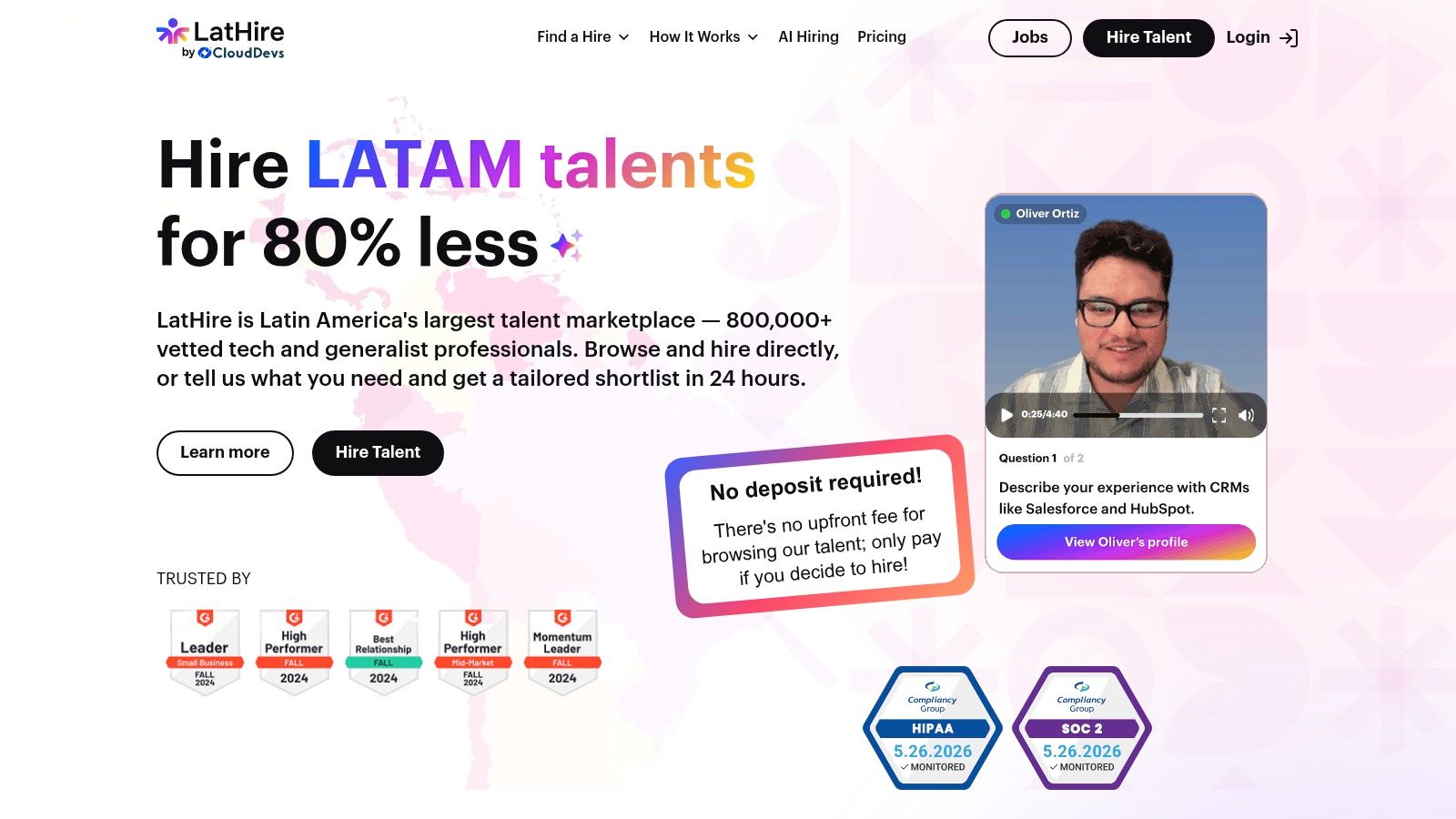
LatHire is an AI-powered hiring platform connecting U.S. and Canadian companies with pre-vetted Latin American professionals across technology, marketing, sales, and operations. Its process combines AI assessments, skills evaluations, and human-led background checks, which can reduce the amount of early screening a hiring manager must perform.
The platform says its talent pool includes more than 800,000 candidates, with matching that can happen as fast as 24 hours. It also provides support for HR, international payroll, benefits, and legal compliance. Those features address the problems that make direct hiring difficult, particularly when a company needs a candidate quickly but doesn't have local operational infrastructure.
Where the model fits
LatHire is most useful when you need a specialist or a dependable generalist and want one process for sourcing, matching, and cross-border administration. The platform supports roles ranging from AI engineers, DevOps professionals, and UX/UI designers to customer-support staff, recruiters, and administrative assistants. Profiles include validated skills, availability, time-zone information, and flexible engagement options.
Before using any managed platform, prepare a concise scorecard:
- Define the live window: State the required working hours in your company's time zone.
- List required skills: Separate essential tools from skills that can be learned.
- Specify language tasks: Distinguish email, live calls, translation, and customer escalation.
- Set the first-month outcomes: Identify the workflows the hire must own before autonomy expands.
- Clarify the support model: Confirm who handles performance concerns, payroll questions, and replacement needs.
Companies comparing role types can review LatHire's guide to latin american virtual assistants for a more focused view of the talent category. The platform is less suitable when you only need a one-off task, already have strong local hiring support, or want complete control over every employment detail.
Onboarding Remote Assistants for Real Productivity
A strong hire can still underperform if the company provides scattered instructions, incomplete access, and vague priorities. Remote assistants need the same operating context as local employees, but the context must be documented because informal desk-side learning isn't available.
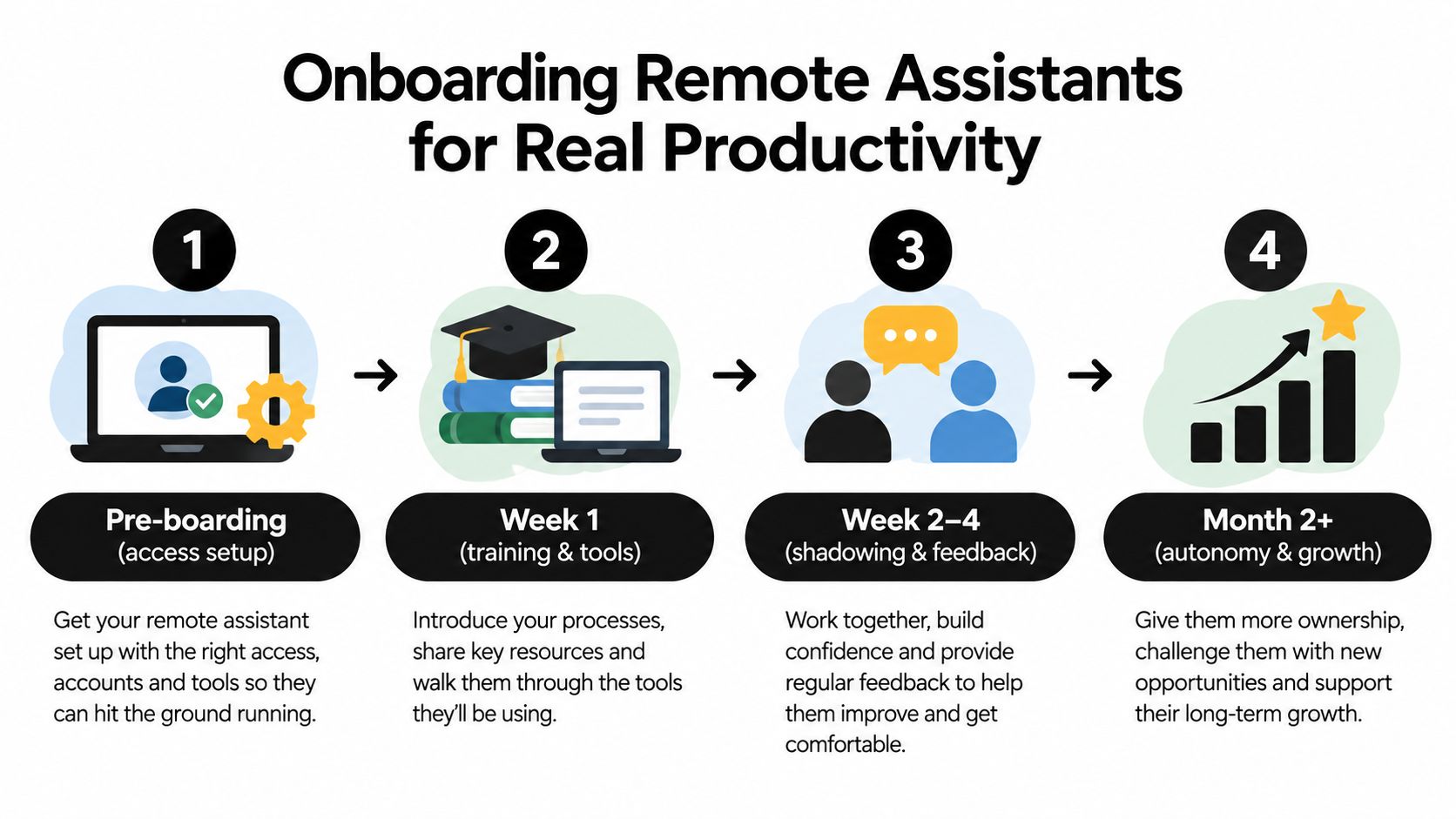
Begin before the first working day. Create individual accounts, prepare a role dashboard, gather standard operating procedures, and decide which actions require approval. Never give broad access only because it feels faster. Use a password manager, role-based permissions, and a clear offboarding checklist.
Build the first month around ownership
The first week should establish the operating environment. Show the assistant where work arrives, how priorities are assigned, which tools matter, and what a completed task looks like. Keep initial responsibilities repeatable, such as inbox triage, CRM updates, calendar coordination, or recurring reports.
During the next phase, move from observation to controlled execution. Shadow customer calls, review the first outputs quickly, and record recurring questions in the relevant procedure. A useful task template includes:
- Trigger: What starts the work?
- Procedure: Which steps and tools should the assistant use?
- Output: What does completion look like?
- Escalation: Which conditions require a manager?
By the time the assistant owns a workflow, your manager should review quality by outcomes rather than online presence. Measure completed work, accuracy, response quality, exception handling, and the number of revisions needed. The exact measure depends on the role, but it should be visible to both sides.
Combine human coordination with AI assistance
AI can help an assistant draft responses, summarize calls, translate working notes, prepare research briefs, and convert one approved source into multiple formats. The assistant should decide whether the output is accurate, appropriate, and safe to send.
For example, a content assistant might use AI to create a first draft and metadata options. The human then checks facts, tone, regional vocabulary, links, and claims before publication. A support assistant might use AI to classify incoming tickets, but retain responsibility for account-specific replies and escalations.
The workflow should include regular feedback. Hold short check-ins early, then reduce them as the assistant demonstrates reliable judgment. When the same correction appears repeatedly, update the procedure rather than repeating the correction privately.
Using AI Tools Alongside Human Assistants
The most useful question isn't whether AI replaces a virtual assistant. It's which parts of the workflow benefit from speed, and which require accountable judgment.
AI is well suited to high-volume preparation. An assistant can use it to draft customer replies, translate internal notes, summarize research, generate content briefs, create metadata, categorize tickets, and repurpose an approved article into social or email formats. These tasks are valuable because they reduce repetitive effort without transferring final responsibility to an opaque system.
Human ownership remains essential where context or risk matters. A person should approve customer-facing claims, interpret ambiguous account situations, verify names and monetary amounts, resolve cultural nuance, and decide when a request must be escalated. The assistant also needs to recognize when an AI output sounds fluent but is wrong.
A practical workflow has three layers:
| Layer | Suitable work | Human responsibility |
|---|---|---|
| Preparation | Drafting, transcription, translation, summarization | Check whether the input was understood |
| Production | Formatting, classification, metadata, repetitive variations | Apply role-specific rules |
| Approval | Customer replies, financial records, sensitive content | Make the final decision and document exceptions |
Separate data, prompts, and credentials
Don't place client credentials inside a general-purpose prompt library. Keep passwords in an approved password manager, restrict access by role, and remove unnecessary personal or account information before sending material to an AI tool.
Create prompt templates that state the audience, task, source material, prohibited assumptions, and review requirements. Store approved examples separately from experimental prompts. That separation helps the assistant understand which instructions are production-ready and which are still being tested.
Regional AI adoption makes this governance practical rather than theoretical. The Economic Commission for Latin America and the Caribbean reports that Latin America and the Caribbean account for 14% of global visits to AI solutions and rank third worldwide in generative-AI application downloads, with strong demand from micro, small, and medium-sized businesses. The regional AI policy analysis also identifies gaps in talent, investment, and public policy.
Review for language and cultural accuracy
A Spanish-language output can be grammatically correct yet wrong for the intended country, audience, or level of formality. A Portuguese output for Brazil needs its own review standard rather than a Spanish adaptation with vocabulary changed mechanically.
Use country-specific test examples. Include local names, addresses, currencies, colloquialisms, interruptions, and customer objections. For voice workflows, score transcription errors separately from wrong intent, hallucinated answers, failed handoffs, and context lost during transfer. Long pauses should preserve the conversation state rather than resetting it without notice.
Teams that want to compare AI-assisted remote-work patterns can also review this guide to AI chat in remote work. The durable model is not full automation. It is a human assistant who uses AI for volume and speed while retaining responsibility for quality, privacy, and judgment.
Pricing, Contracts, and Cross-Border Compliance Basics
The cheapest hourly rate is often the least useful comparison. A candidate who needs heavy revision, misses customer nuance, or requires repeated explanations can cost more than a higher-rate assistant who owns the workflow correctly.
Think in terms of cost per reliable outcome. Define whether you're buying availability, deliverables, customer coverage, or specialist judgment. A fixed project may suit a defined research task. An hourly or monthly arrangement may suit inbox management, support coverage, or evolving operations work. The contract should match the uncertainty of the work.
Price the role, not the label
A generic “virtual assistant” title conceals meaningful differences. A bilingual support role with escalation responsibility requires a different screen and rate from a data-cleanup assignment. A marketing assistant who can brief writers, manage publishing, and review analytics carries more operational responsibility than someone formatting supplied copy.
Ask candidates or providers to separate:
- Core availability: The hours during which live coverage is required.
- Deliverables: The work product expected in a defined period.
- Specialist capability: Language, industry, software, or technical expertise.
- Management support: Training, supervision, replacement, and administration.
- Review burden: The level of checking your internal team must provide.
A lower quote is attractive only if the output is usable. If your manager rewrites every customer response or rebuilds every report, the rate has hidden labor attached to it.
Put the important terms in writing
A cross-border agreement should clearly describe the services, schedule, payment terms, confidentiality obligations, intellectual-property ownership, security expectations, performance standards, and termination process. Include the tools the assistant may access and the process for returning or deleting company information.
Specify who owns work created during the engagement. Clarify whether the assistant may use subcontractors, copy company data into external tools, or retain examples for a portfolio. If AI tools are allowed, identify approved systems and the categories of information that must stay out.
Contract test: If two reasonable people could interpret a responsibility differently, the agreement isn't finished.
Treat compliance as country-specific
Payment methods, tax documentation, labor expectations, benefits, worker classification, and termination rules vary by country. A contract suitable for one Latin American market may not address the obligations created by another. Direct hiring deserves local legal and payroll advice, particularly when the role is ongoing, tightly supervised, or economically dependent on one company.
An agency or employer-of-record-style arrangement may reduce administration, but it doesn't remove your obligations around data security, access control, confidentiality, and day-to-day management. Ask exactly who signs the contract, who processes payment, who handles required documentation, and who is responsible if the engagement ends.
Before granting access, create a simple security inventory:
- List the systems: CRM, support desk, email, finance tools, cloud storage, and analytics.
- Assign minimum permissions: Give access to the information required for the role, not the whole account.
- Use individual credentials: Avoid shared passwords and keep access revocable.
- Record approved AI tools: State what data may be entered and what must be excluded.
- Prepare offboarding: Remove access, transfer files, rotate secrets, and confirm deletion where appropriate.
Good compliance protects both parties. It also makes the working relationship easier because expectations are established before the first urgent request arrives.
Common Mistakes That Sink Virtual-Assistant Hires
The first mistake is treating Latin America as one interchangeable market. A Spanish-speaking assistant, a Portuguese-speaking Brazilian specialist, and a bilingual customer-support professional may solve entirely different problems. Country selection should follow the role's language, schedule, customer base, and operational requirements.
The second mistake is treating hourly price as value. Low-cost hiring can fail through weak writing, poor handoffs, limited availability, or constant review. The relevant question is whether the assistant can produce dependable work at the required quality with a reasonable amount of management.
Warning signs appear early
Watch for patterns rather than isolated mistakes:
- Repeated clarification requests: The role may be poorly documented, or the assistant may lack the required judgment.
- Polished but inaccurate output: AI-assisted or template-driven work may hide weak source checking.
- Missed handoffs: The working window, escalation path, or communication channel may not be explicit.
- Defensive responses to feedback: The assistant may struggle with the collaborative nature of the role.
- Unexplained availability changes: The schedule may not be sustainable or may never have been confirmed properly.
Corrective action should be specific. Rewrite the task definition, demonstrate one complete example, set an approval boundary, and review the next outputs against a shared checklist. If the same issue continues after clear instruction and a fair trial, the problem is probably fit rather than training.
Avoid the shortcuts that create rework
Skipping spoken-language testing is risky for customer-facing work. Relying only on a country reputation is equally weak because individual ability varies widely. Using scripted test audio can hide failures with accents, interruptions, noisy mobile connections, long pauses, names, and addresses.
Poor onboarding creates another avoidable failure. Assistants can't infer undocumented priorities, access rules, or brand voice from a job title. Give them a real operating manual, controlled access, examples of acceptable work, and a defined escalation route.
The strongest hiring process is disciplined without being elaborate. Define the workflow, choose the country based on actual constraints, test language and task ability, document the engagement, onboard deliberately, and use AI where it increases volume without removing human accountability.
If you're ready to turn this framework into a repeatable content and operations workflow, use AI4Chat to compare AI outputs for research, drafting, translation, and multi-format production, then have your human assistant review every customer-facing result before publication or delivery.